Features
One workflow from books to reports
Work of a CA, auditor or finance team in one Windows desktop application, with AI that answers from the books.
- 225225ready reports
- 128128audit exception rules
- 2121CA tools + 4 document tools
- 88AI personas
Feature groups
Connect
Auto-detect, live or file. Any company, any period.
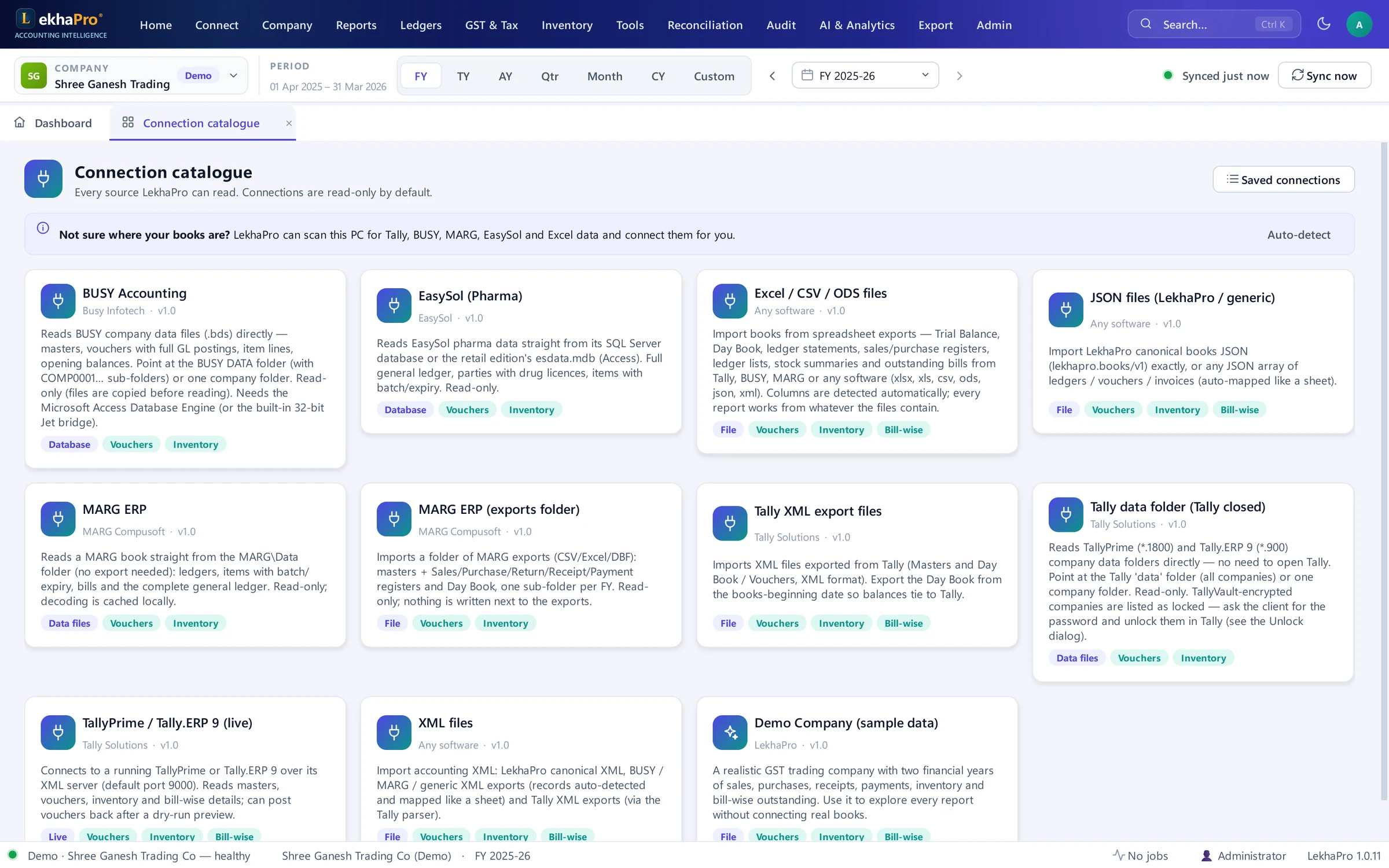
- Finds accounting software and company data on this PC
- TallyPrime / Tally.ERP 9 live, or the data folder with Tally closed
- BUSY, MARG ERP and EasySol without exporting first
- Two-year trial balance import for any other software
- FY, AY, TY, quarter, month or custom range
Statements & Books
Schedule III, notes, designer and multi-year comparatives.
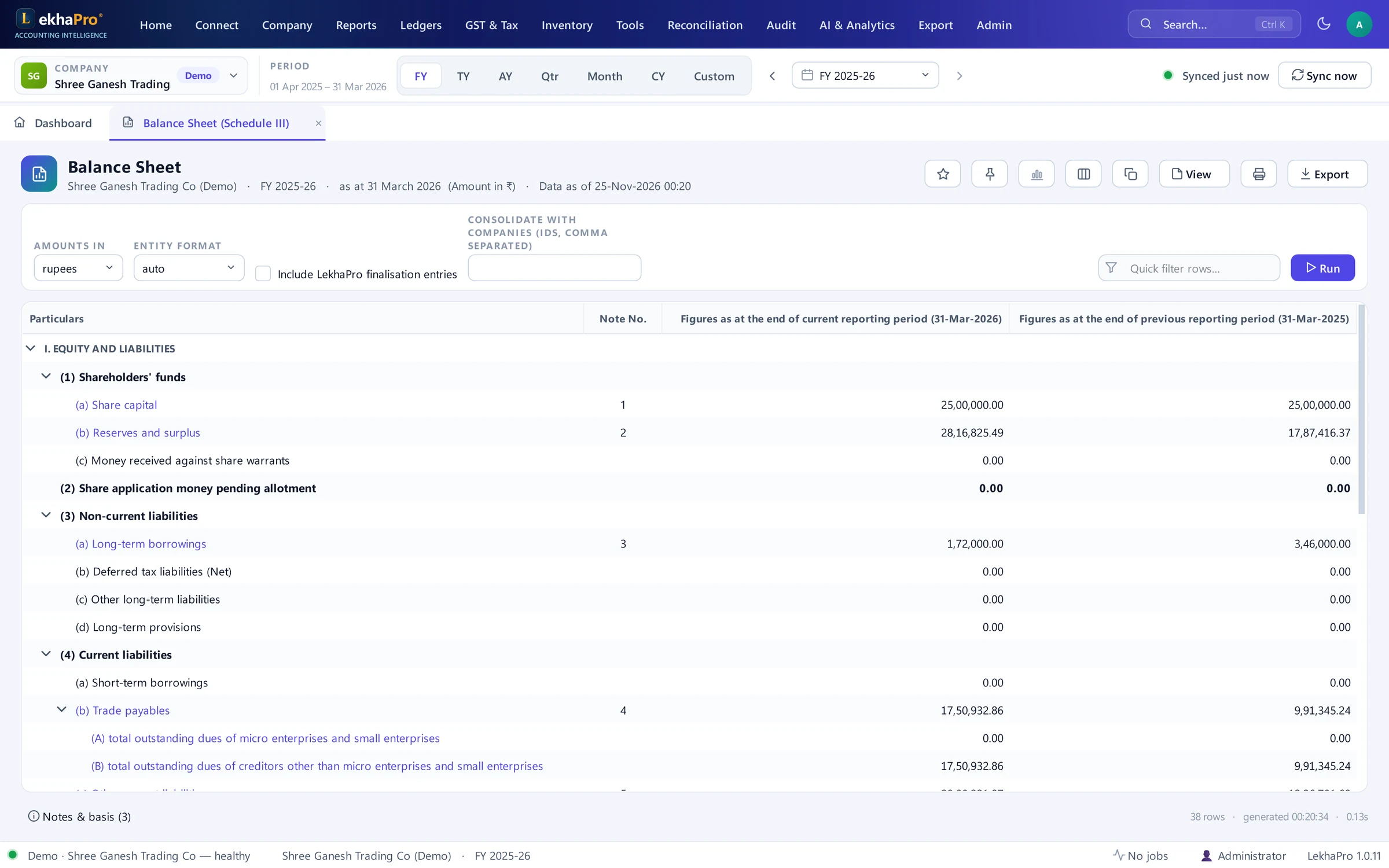
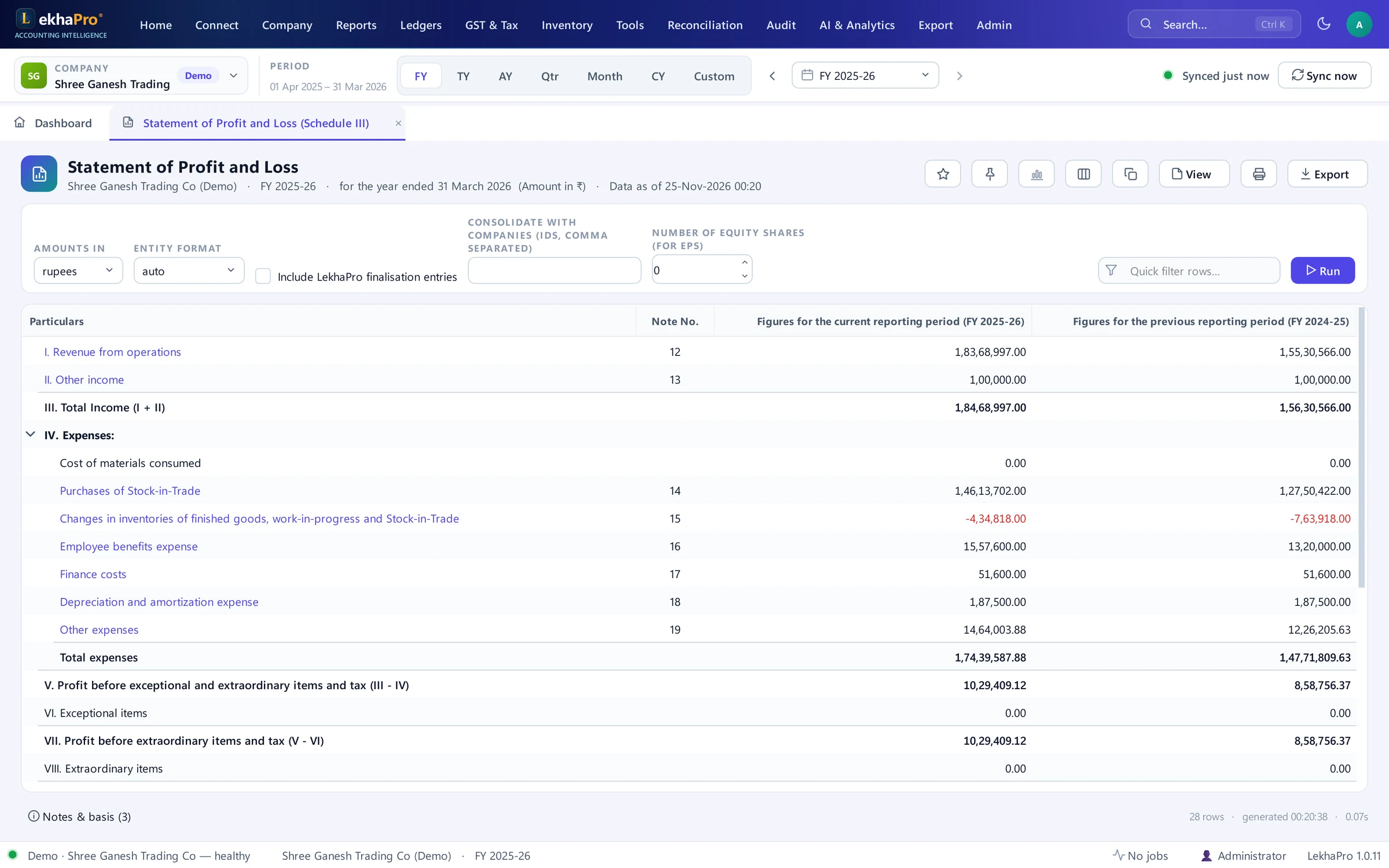
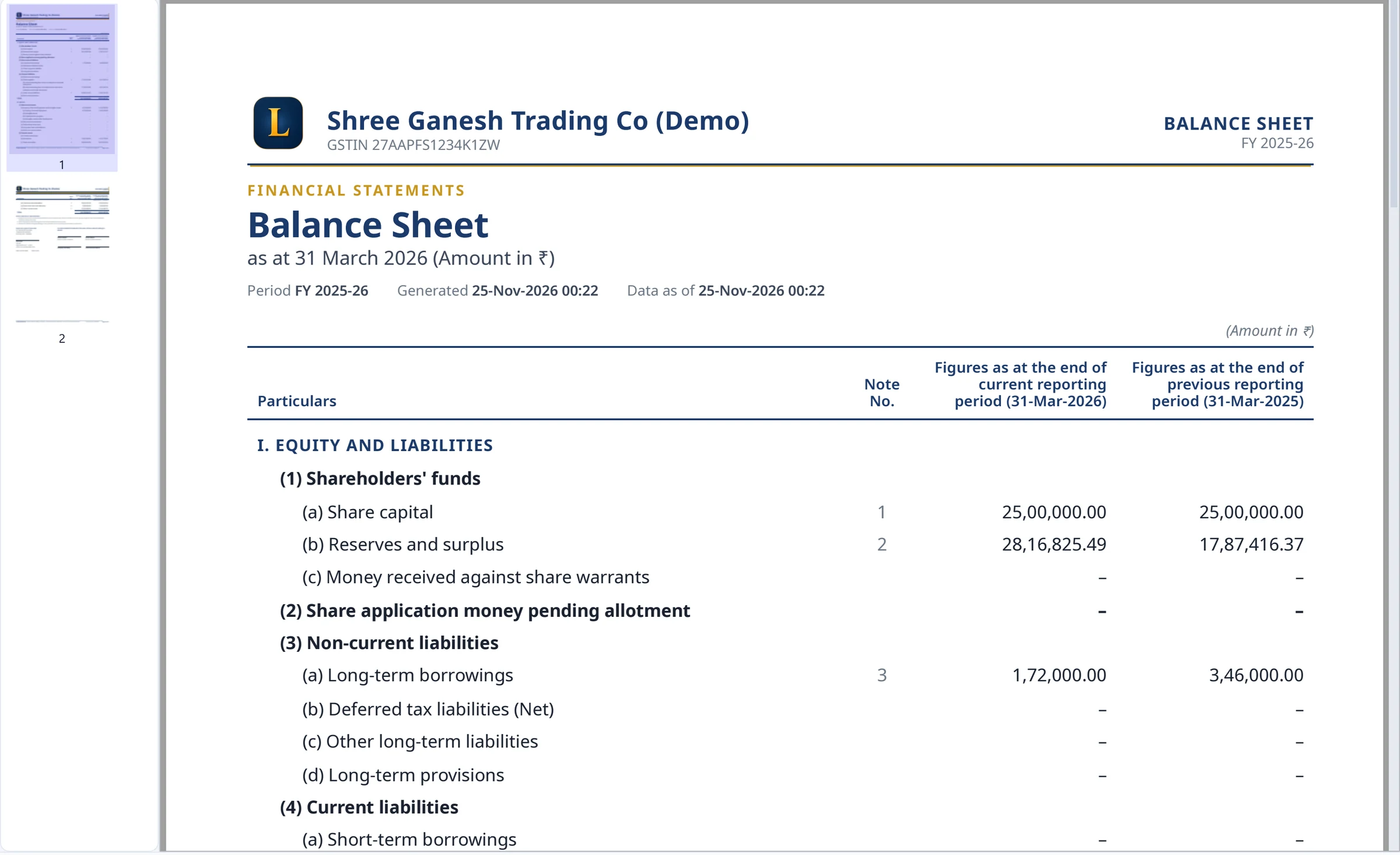
- Schedule III Balance Sheet and P&L with the previous year
- Notes to accounts, ageing, MSME disclosure and ratios
- Cash flow (indirect and direct) and funds flow
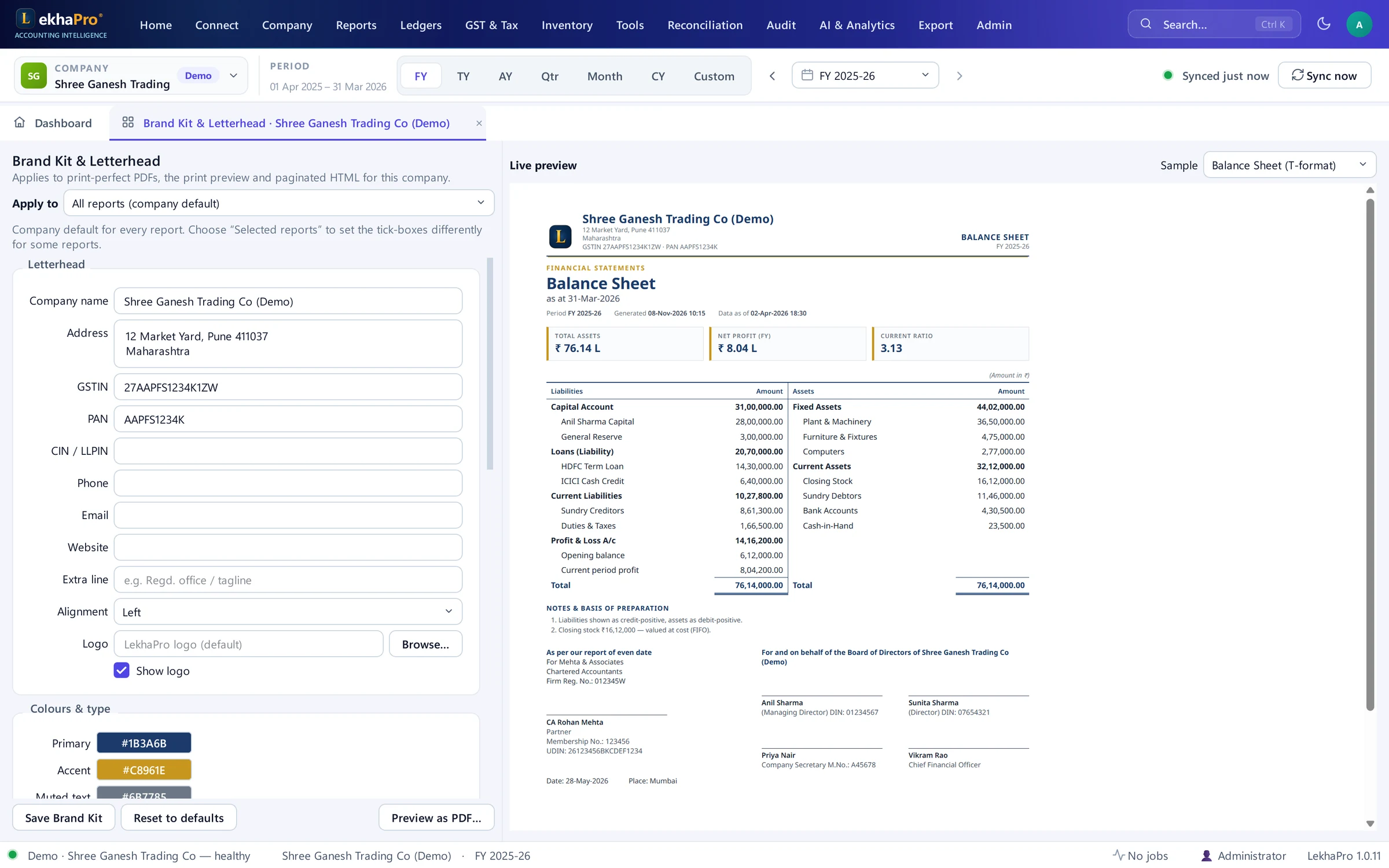
- Schedule III Designer with a live preview per client
- Multi-year analysis: trends, growth and ratios
GST & Portal Files
GSTR-1, 3B, 9, e-invoice, TDS and more, checked first.
- GSTR-1 portal JSON and Offline Tool Excel, GSTR-3B JSON
- GSTR-9 annual return and 9C worksheet
- E-invoice and e-way bill bulk files
- TDS 26Q / 24Q statement data, Form 3CD clause data, ITR Part A-BS / P&L
- AOC-4 draft, MSME Form-1 and compliance calendar
Reconciliation
Bank, GSTR-2A / 2B, IMS and GSTR-1.
- Bank reconciliation with auto-match and BRS
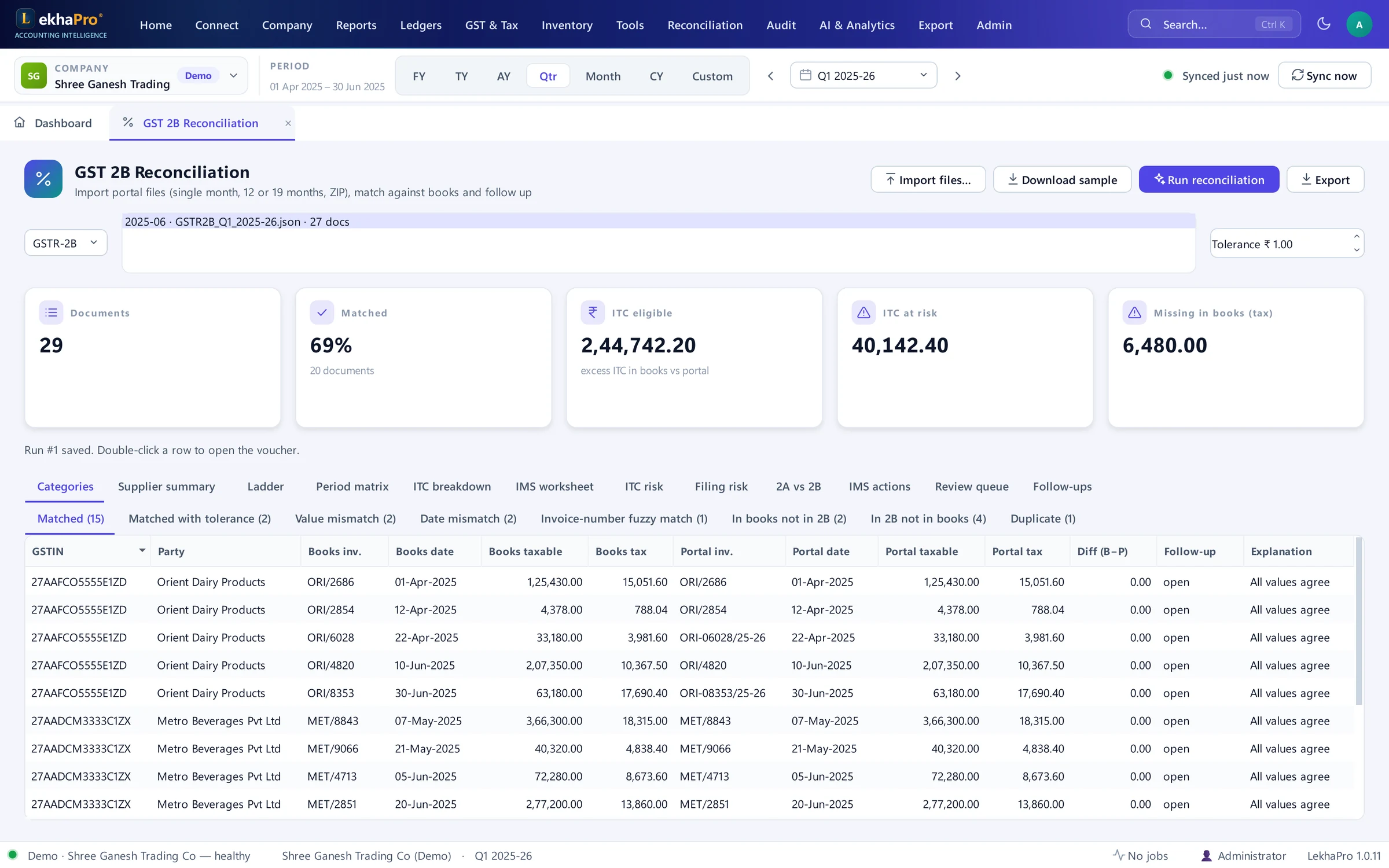
- Books vs GSTR-2B / 2A with fuzzy invoice numbers
- IMS worksheet: accept, reject or pending
- Filed GSTR-1 compared with the sales books
- ITC at risk and supplier follow-up letters
Year-end & Assets
Finalisation entries, fixed asset register and tax.
- Finalisation entries kept outside the source books, maker-checker with two or more users
- Year-end readiness checklist
- Fixed Asset Register reconciled to the ledger
- Companies Act and Income-tax depreciation
- Salary tax (old vs new regime), budgets and forecast
Audit
128 exception rules, sampling, CARO and engagements.
- Exception Library of 128 rules, tuned per company
- 40A(3), 269ST, duplicates, back-dated entries, Benford
- Sampling rules (SA 530) and differences (SA 450)
- CARO 2020 builder and observations register
- Anomaly Centre ranks unusual transactions
Documents & OCR
Bills to voucher drafts, read on your own PC.
- Offline OCR for invoices, bills and receipts
- GSTIN, invoice number, date, value and tax extracted
- Confidence score and position on the page
- Duplicate-bill check before booking
- Approved drafts to Tally XML or Excel
AI & Analytics
Ask your accounts, forecasts, MIS and Report Studio.
- Answers from the company's own books, with sources
- Eight personas, with full effect when online AI is on
- Daily briefing, forecasts and what-if scenarios
- Pivot tables and charts in Report Studio
- Built-in AI on your PC; online AI is optional and needs your consent and API key
CA Tools
21 CA tools + 4 document tools.
- PDF toolkit and PDF editor
- Interest, late-fee and capital gains calculators
- 26AS / AIS and GSTR-2B matchers
- Notices, UDIN, DSC and fee billing registers
- Certificates, letters and agreement summaries
Reports
225 ready reports
No report to design and no template to set up. Pick the company and period and open any report.
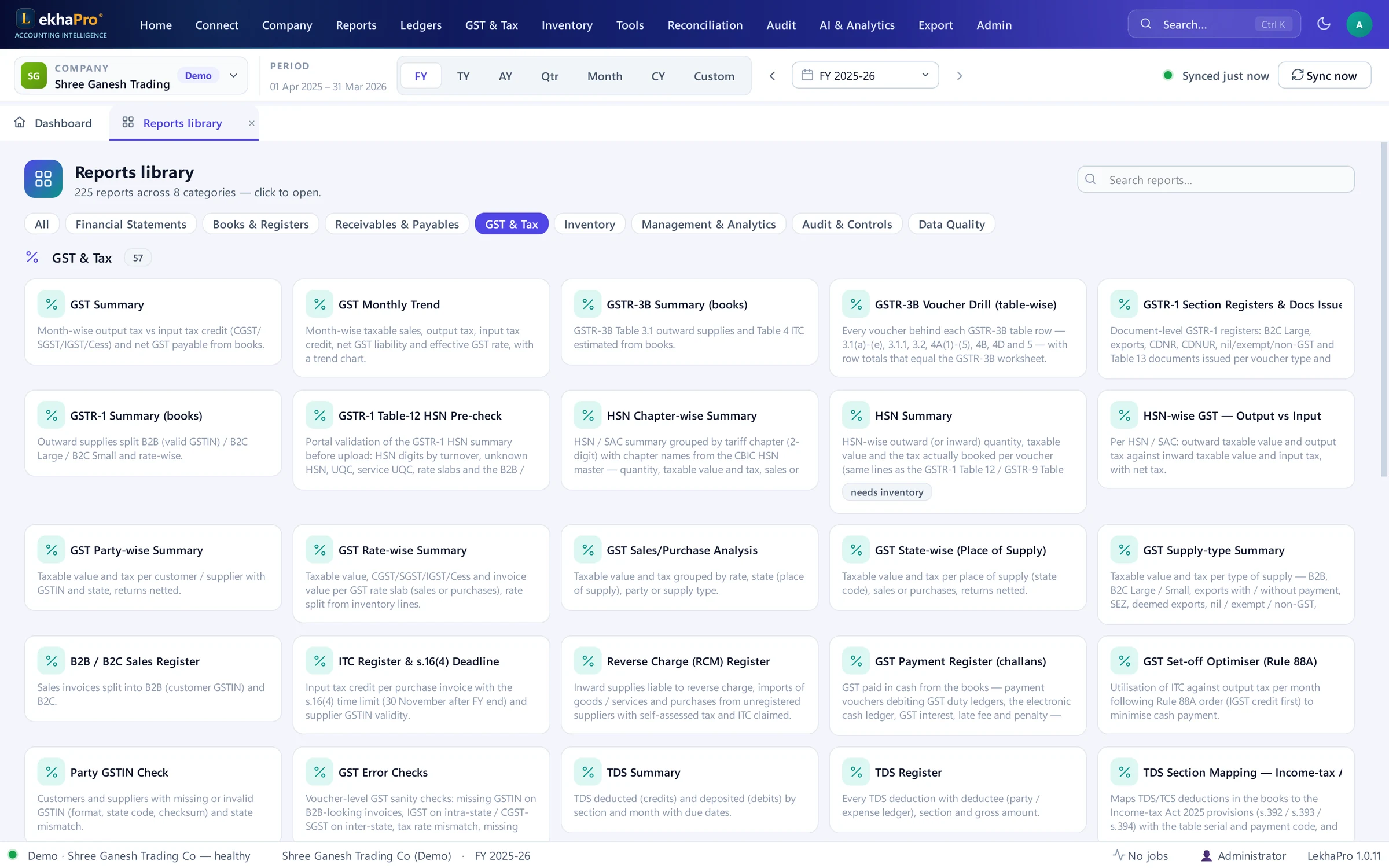
57 reports in GST & Tax
GST & Tax 57
GST Summary
Month-wise output tax vs input tax credit (CGST/SGST/IGST/Cess) and net GST payable from books.
GST Monthly Trend
Month-wise taxable sales, output tax, input tax credit, net GST liability and effective GST rate, with a trend chart.
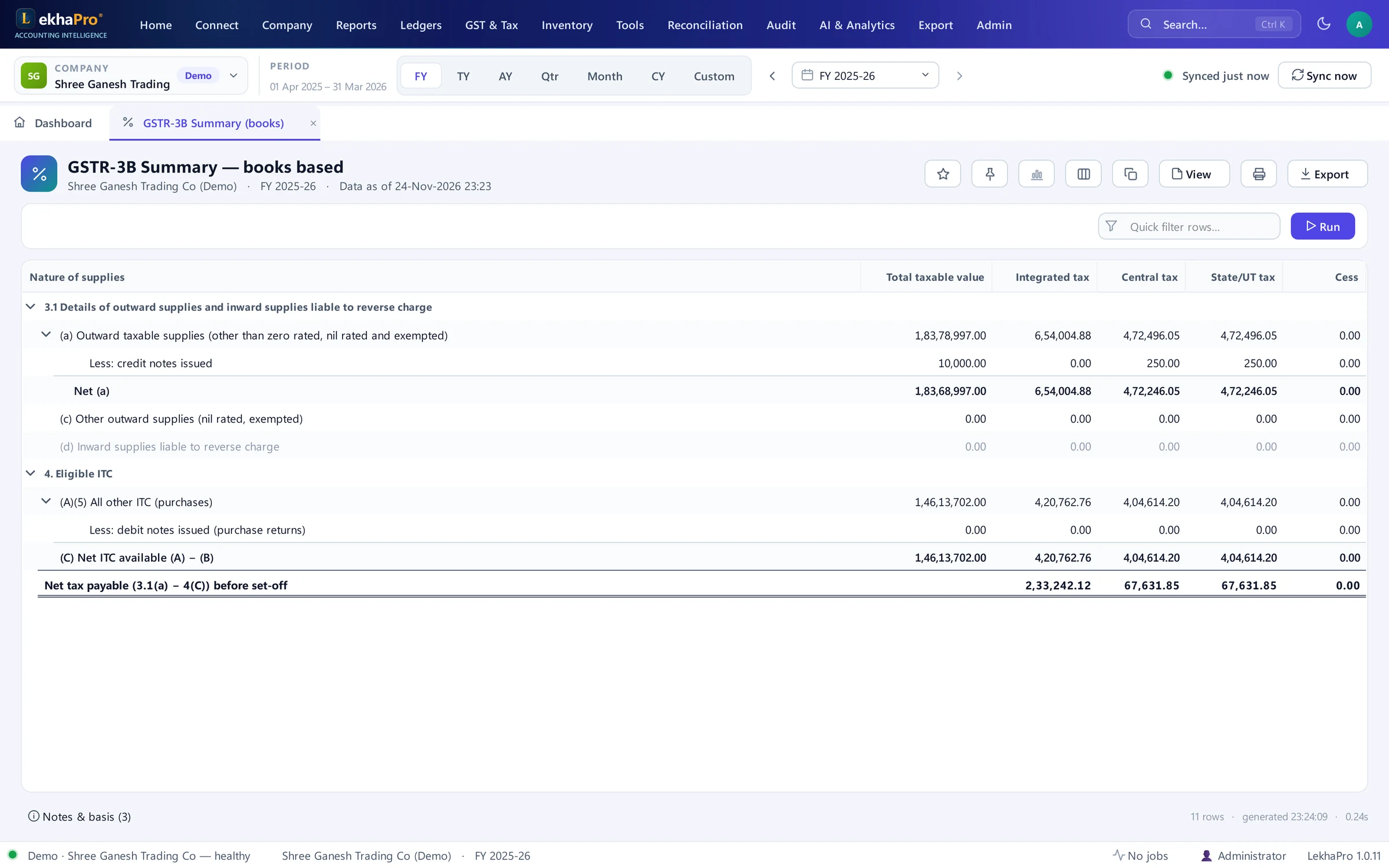
GSTR-3B Summary (books)
GSTR-3B Table 3.1 outward supplies and Table 4 ITC estimated from books.
GSTR-3B Voucher Drill (table-wise)
Every voucher behind each GSTR-3B table row — 3.1(a)-(e), 3.1.1, 3.2, 4A(1)-(5), 4B, 4D and 5 — with row totals that equal the GSTR-3B worksheet.
GSTR-1 Summary (books)
Outward supplies split B2B (valid GSTIN) / B2C Large / B2C Small and rate-wise.
GSTR-1 Section Registers & Docs Issued
Document-level GSTR-1 registers: B2C Large, exports, CDNR, CDNUR, nil/exempt/non-GST and Table 13 documents issued per voucher type and number series.
HSN Summary
HSN-wise outward (or inward) quantity, taxable value and the tax actually booked per voucher (same lines as the GSTR-1 Table 12 / GSTR-9 Table 17-18 HSN summary).
HSN Chapter-wise Summary
HSN / SAC summary grouped by tariff chapter (2-digit) with chapter names from the CBIC HSN master — quantity, taxable value and tax, sales or purchases, returns netted.
HSN-wise GST — Output vs Input
Per HSN / SAC: outward taxable value and output tax against inward taxable value and input tax, with net tax.
GSTR-1 Table-12 HSN Pre-check
Portal validation of the GSTR-1 HSN summary before upload: HSN digits by turnover, unknown HSN, UQC, service UQC, rate slabs and the B2B / B2C split against the invoice tables.
GST Sales/Purchase Analysis
Taxable value and tax grouped by rate, state (place of supply), party or supply type.
GST Rate-wise Summary
Taxable value, CGST/SGST/IGST/Cess and invoice value per GST rate slab (sales or purchases), rate split from inventory lines.
GST State-wise (Place of Supply)
Taxable value and tax per place of supply (state code), sales or purchases, returns netted.
GST Party-wise Summary
Taxable value and tax per customer / supplier with GSTIN and state, returns netted.
GST Supply-type Summary
Taxable value and tax per type of supply — B2B, B2C Large / Small, exports with / without payment, SEZ, deemed exports, nil / exempt / non-GST, imports and reverse-charge inward supplies.
B2B / B2C Sales Register
Sales invoices split into B2B (customer GSTIN) and B2C.
ITC Register & s.16(4) Deadline
Input tax credit per purchase invoice with the s.16(4) time limit (30 November after FY end) and supplier GSTIN validity.
Reverse Charge (RCM) Register
Inward supplies liable to reverse charge, imports of goods / services and purchases from unregistered suppliers with self-assessed tax and ITC claimed.
GST Set-off Optimiser (Rule 88A)
Utilisation of ITC against output tax per month following Rule 88A order (IGST credit first) to minimise cash payment.
GST Payment Register (challans)
GST paid in cash from the books — payment vouchers debiting GST duty ledgers, the electronic cash ledger, GST interest, late fee and penalty — with the tax period and challan (CPIN / CIN).
Party GSTIN Check
Customers and suppliers with missing or invalid GSTIN (format, state code, checksum) and state mismatch.
GST Error Checks
Voucher-level GST sanity checks: missing GSTIN on B2B-looking invoices, IGST on intra-state / CGST-SGST on inter-state, tax rate mismatch, missing HSN.
TDS Summary
TDS deducted (credits) and deposited (debits) by section and month with due dates.
TDS Register
Every TDS deduction with deductee (party / expense ledger), section and gross amount.
TDS Section Mapping — Income-tax Act 2025
Maps TDS/TCS deductions in the books to the Income-tax Act 2025 provisions (s.392 / s.393 / s.394) with the table serial and payment code, and the return form (138 / 140 / 143 / 144). Each row also shows the Act that governs it by date (1961 Act before 1-Apr-2026). Advisory.
TDS Interest u/s 201(1A) & Late Fee
Interest at 1.5% per month (or part) for late deposit of TDS deducted, FIFO matching deposits against monthly deductions.
GST Reconciliation (Books vs Portal)
Invoice-level matching of purchase/sales vouchers with GSTR-2B / 2A / GSTR-1.
Depreciation as per Income-tax Act (blocks)
Block-of-assets WDV schedule (ITR Schedule DEP rows) with half rate for < 180 days, additional depreciation and s.50 STCG / STCL.
GST Supplier-wise Reconciliation
Per-supplier matched / mismatched / missing documents and ITC at risk.
Form 3CD Clause 18 — Depreciation
Block-wise depreciation allowable with additions (date put to use, ≥/< 180 days) and deletions for the tax audit report.
GSTR-2B ITC Breakdown
Section-wise 2B totals and the net claimable ITC (credit notes, blocked and IMS-rejected).
GST Reconciliation Ladder
Exact → strong → probable → party-total ladder with mismatch and validation buckets (Books / Portal / Excess).
GST Reconciliation Period Matrix
Period × status matrix of documents and tax (books vs portal).
IMS Worksheet
Invoice Management System actions (accept / reject / pending), deemed acceptance and suggested actions.
Supplier Filing Risk (GSTR-1 / 3B)
Suppliers who have not filed GSTR-1 or GSTR-3B per GSTR-2A — ITC on their invoices is at risk.
GSTR-2A vs GSTR-2B
Documents reported after the 2B cut-off (in 2A, not yet in 2B) and value differences.
GST Supplier Follow-ups
Documents each supplier must report or correct, with the ask and ITC at risk (source for follow-up letters).
ITC Risk Register
Purchase credits at risk: not in GSTR-2B, supplier not filed / GSTIN cancelled, blocked u/s 17(5), Rule 37 (unpaid 180 days), time-barred u/s 16(4). Reviewer decisions persist.
Salary Tax — Old vs New Regime
Per-employee tax under both regimes, beneficial regime, opted liability and TDS u/s 192 balance.
GSTR-1 — Portal / Offline Tool file
GSTR-1 JSON sections with portal validation
GSTR-3B — Portal JSON (books-based)
HSN Summary — Table 12 (B2B/B2C portal format)
GSTR-9 Annual Return & 9C worksheet
E-invoice bulk batch (IRP v1.1)
E-way bill bulk batch (NIC)
ITC-04 — Job-work goods
HSN / SAC validation (items & lines)
Checks item-master and inventory-line HSN codes against the CBIC HSN/SAC catalogue
TDS Form 26Q — quarterly statement
TDS Form 24Q — salary statement
TCS Form 27EQ — quarterly statement
Tax collected at source (s.206C(1) / (1F) / (1H)) per collectee for the quarter: collectee code, PAN, amount received, rate, TCS and deposit — Form 27EQ (Form 143 under the Income-tax Act 2025).
Form 3CA / 3CB — Tax audit report (s.44AB)
Auditor's report under Rule 6G (3CA if audited under another law, else 3CB) — Word / PDF draft
Form 3CD — Tax audit clause data
ITR Part A-BS / Part A-P&L
CARO 2020 checklist
AOC-4 / Schedule III (MCA)
MSME Form-1 — dues to micro/small suppliers
Statutory compliance calendar
Integrations
Works with the books you already keep
No migration. Your source books are never changed unless you approve a posting to Tally.
TallyPrime / Tally.ERP 9
Live or data folderReads a running Tally, or the company folder with Tally closed. Posts back only vouchers you approve after a preview.
BUSY
DirectReads a copy of BUSY data files: masters, vouchers and inventory.
MARG ERP
DirectReads the MARG data folder: masters, vouchers and stock.
EasySol
DirectReads accounting and inventory data from SQL Server or Access.
Excel / CSV / ODS / XML / JSON
File importTrial balance, day book or ledger export. Columns are mapped automatically and the mapping is saved.
Trial Balance import
Two-yearFor any other software: load current and previous year and go straight to reports.
Product names belong to their owners and are used only to say what LekhaPro can read.
Screens
Real screens, sample data
Click the screen in the laptop to see it in full size.
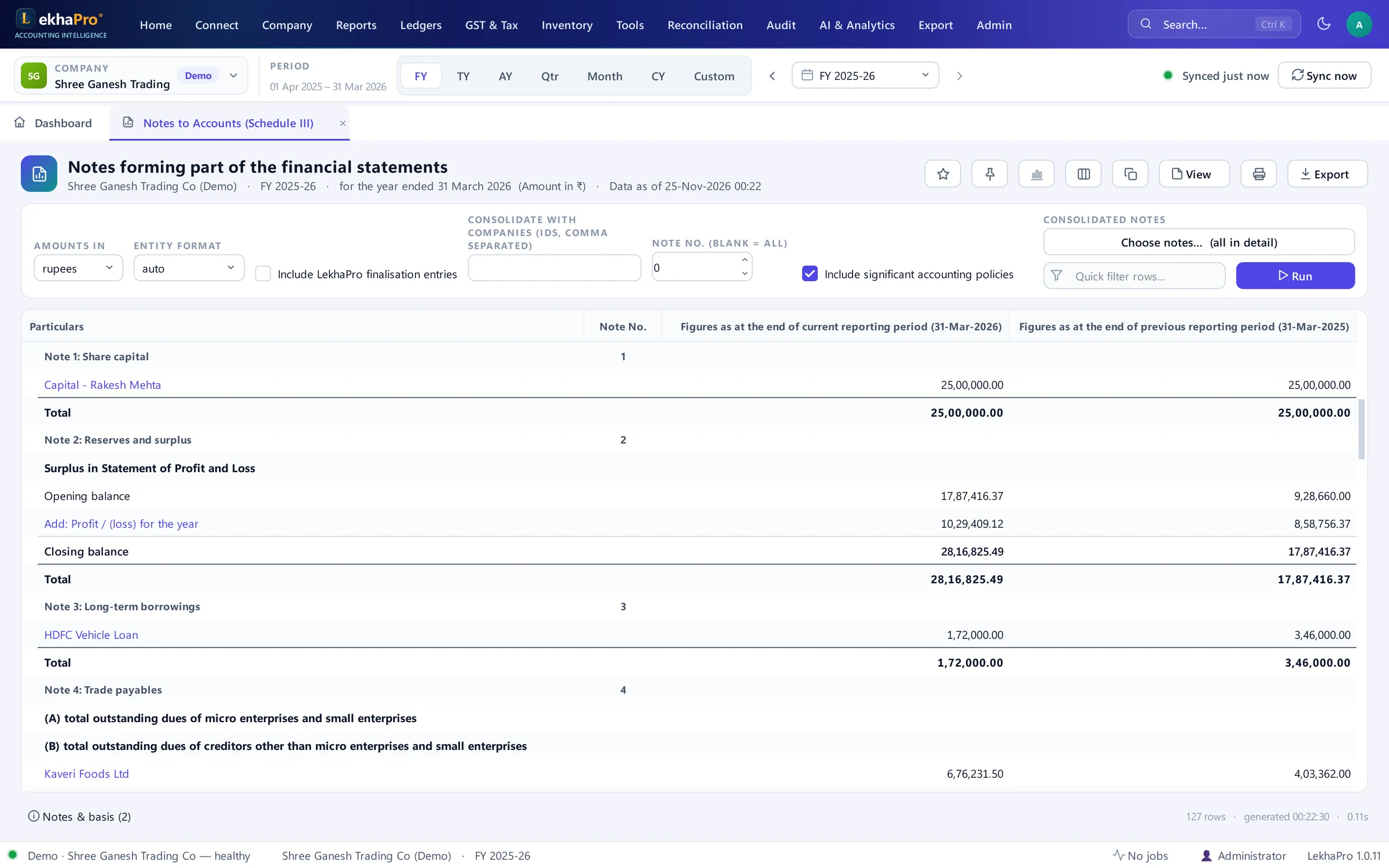
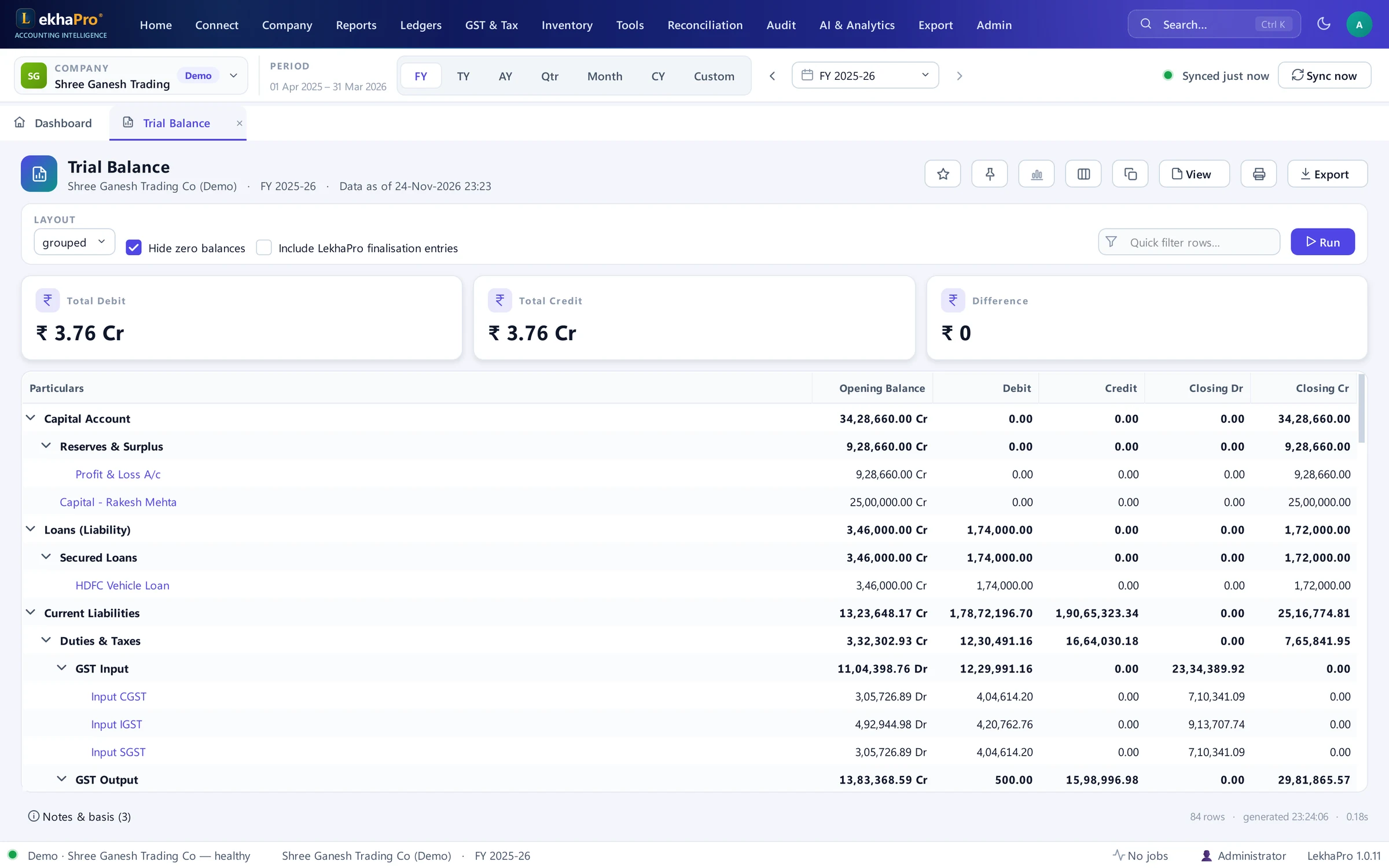
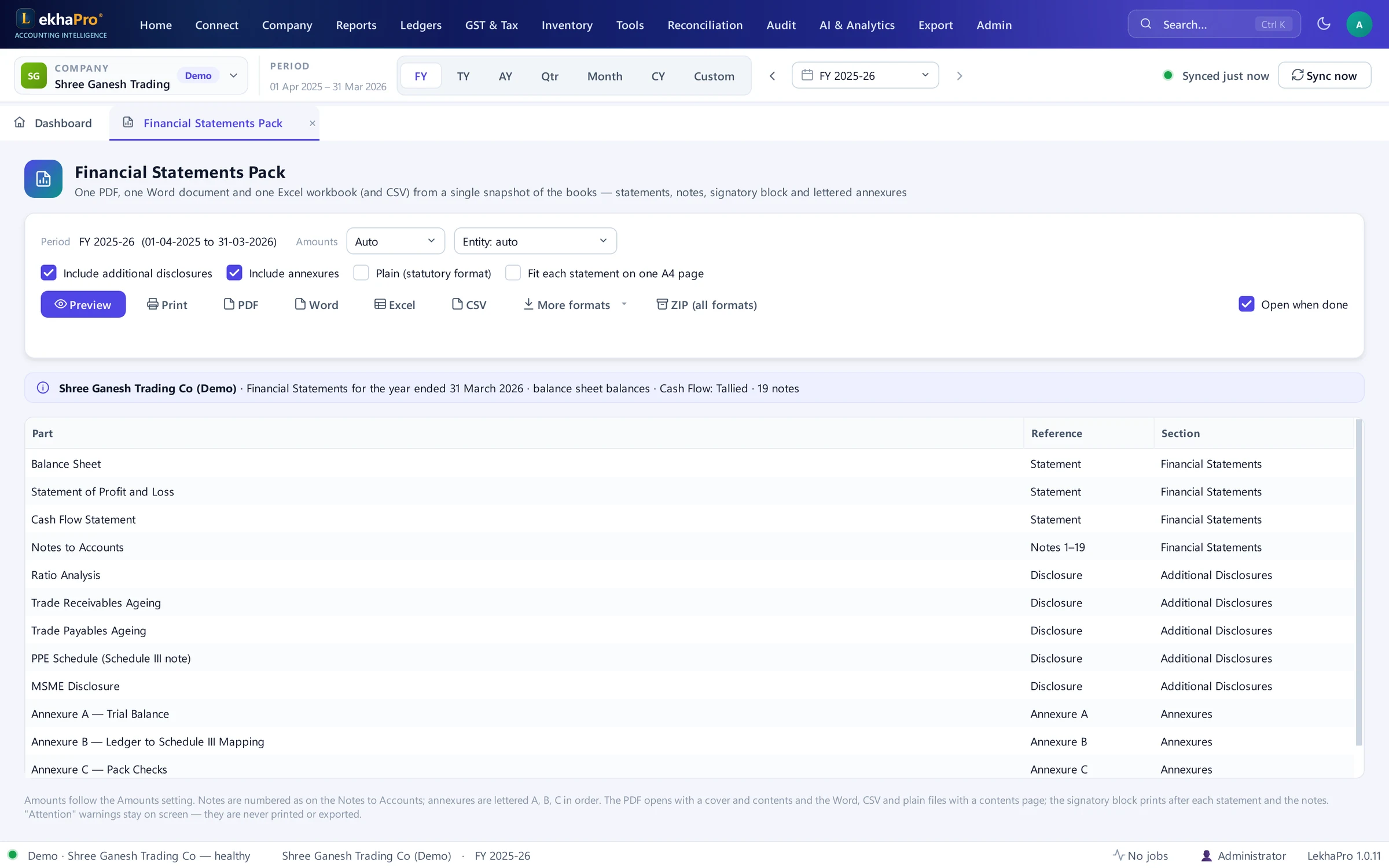
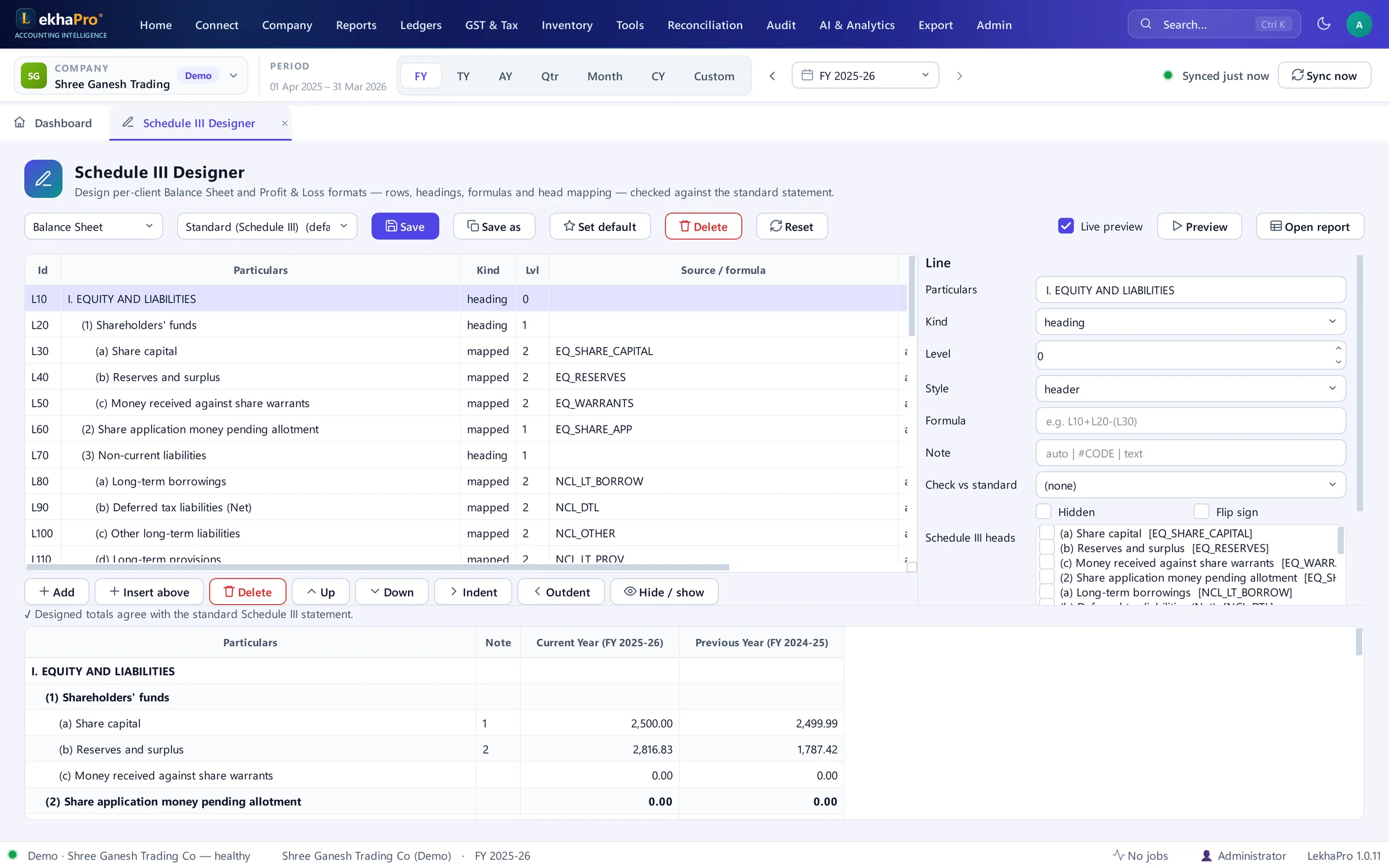
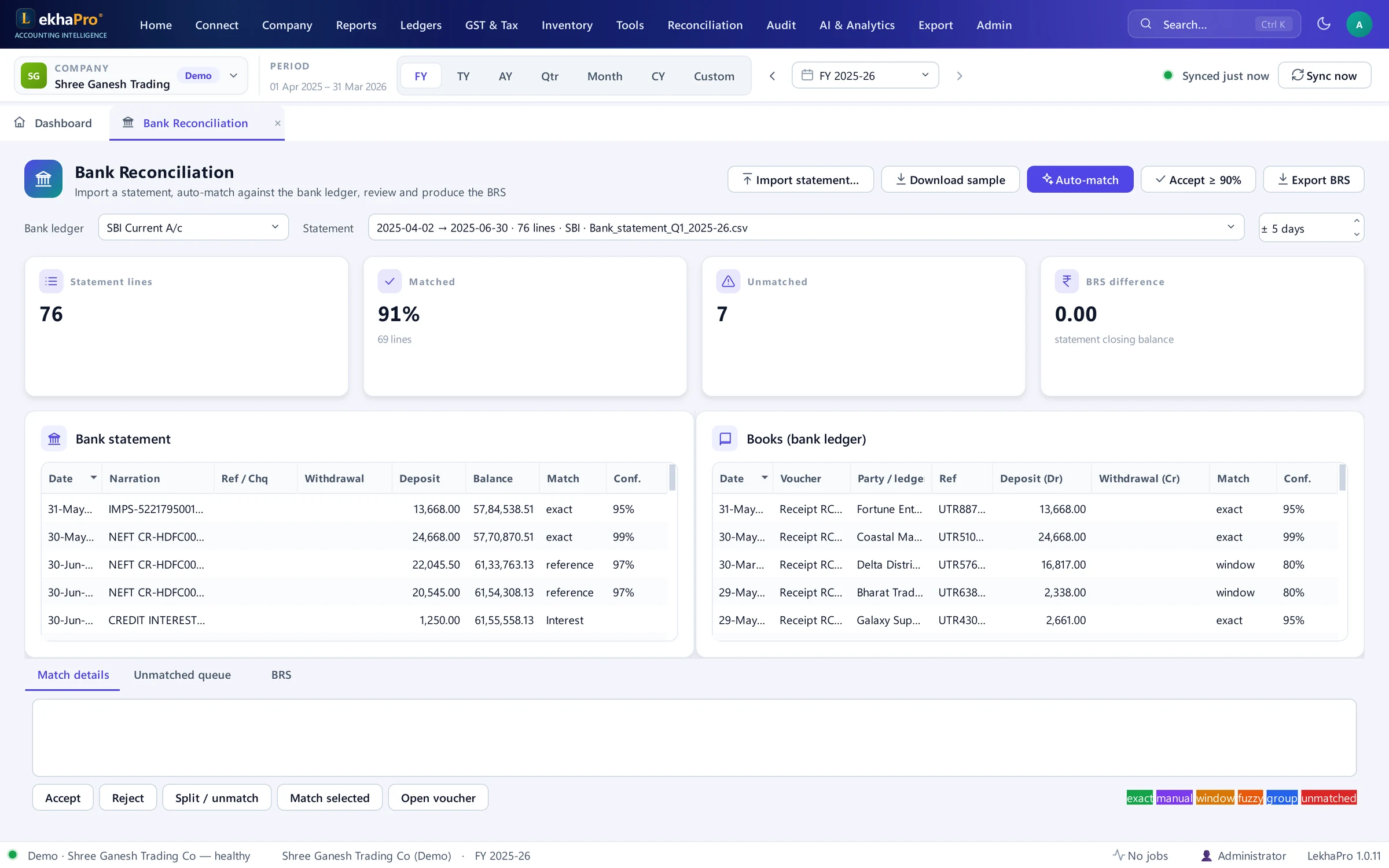
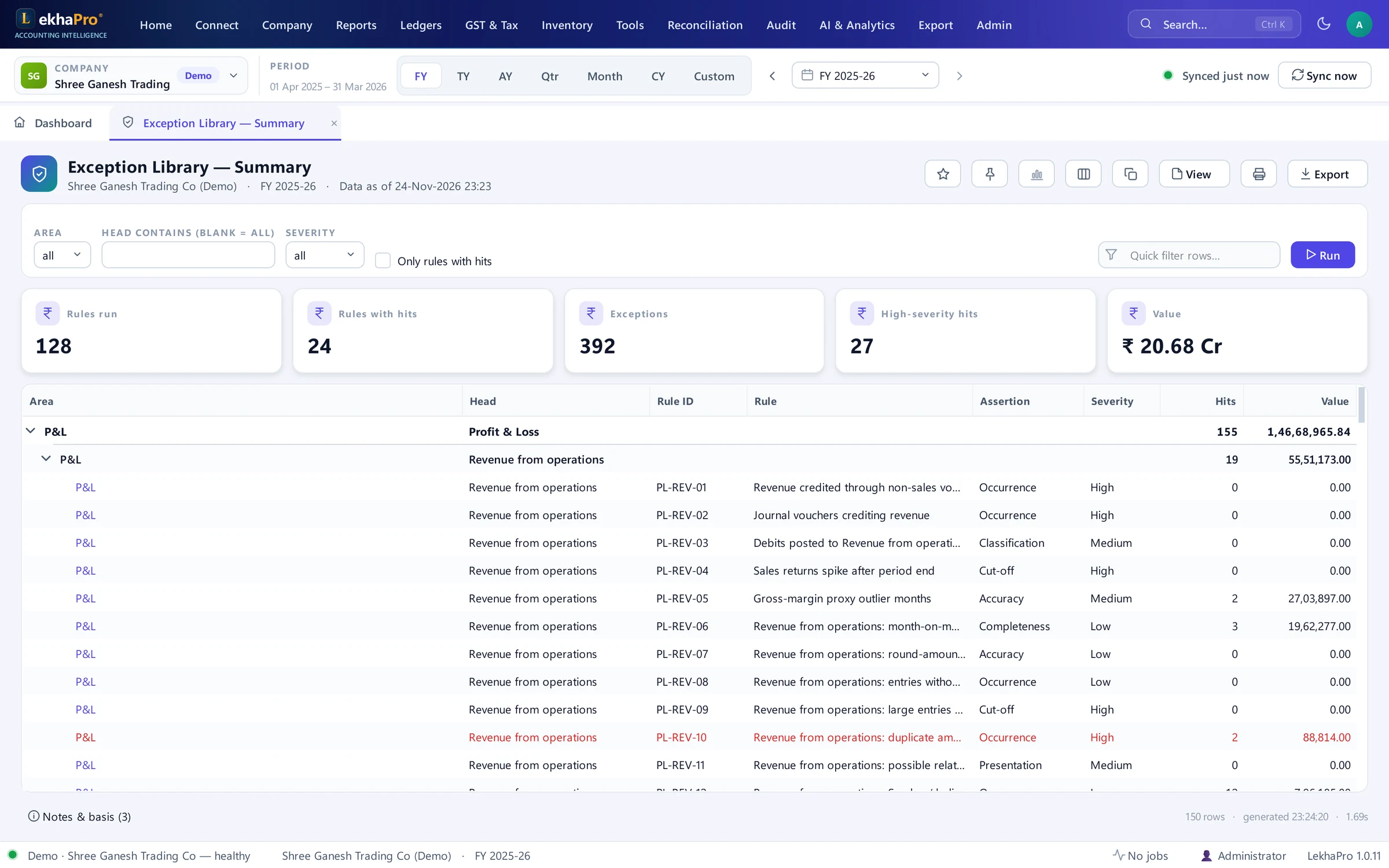
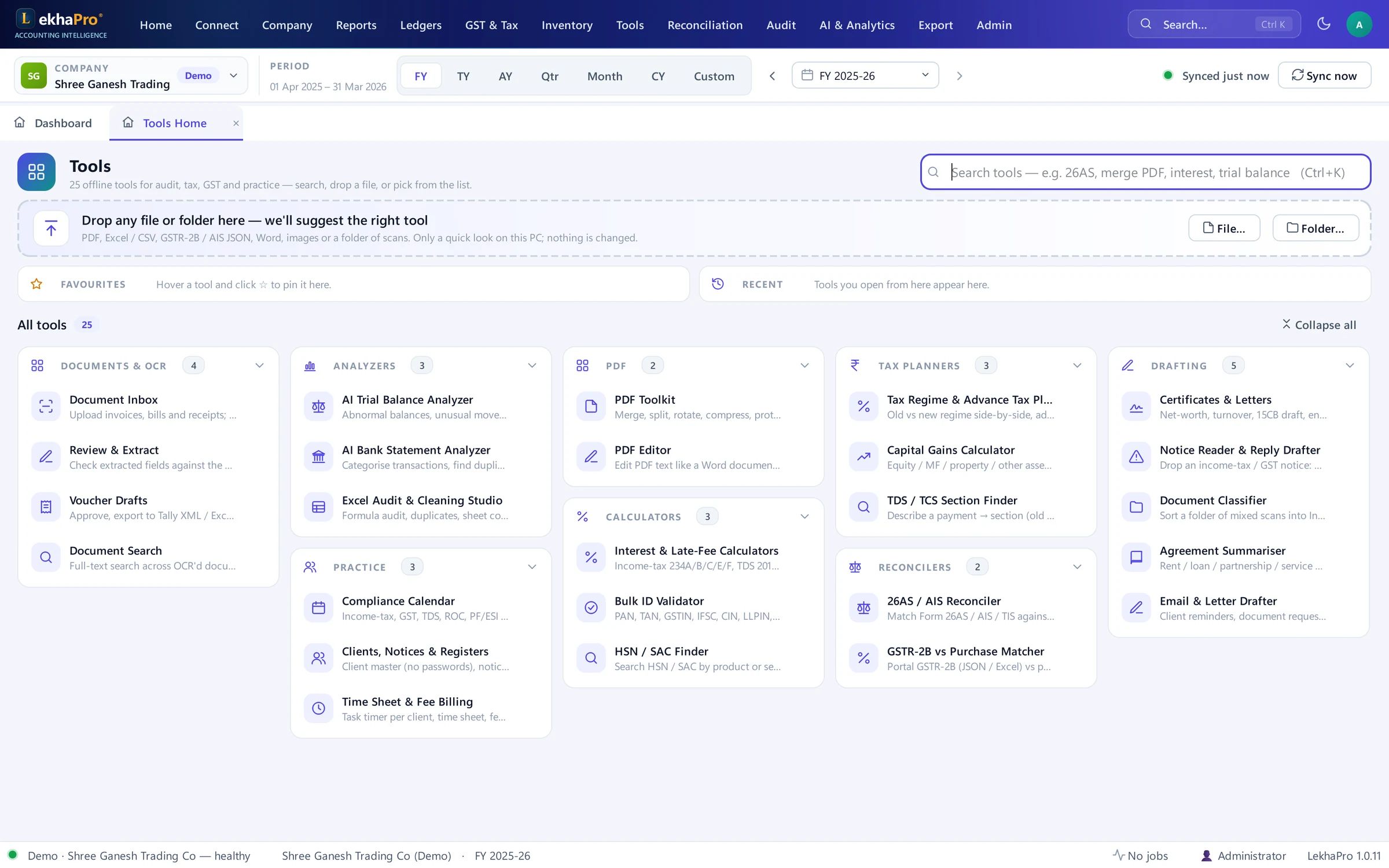
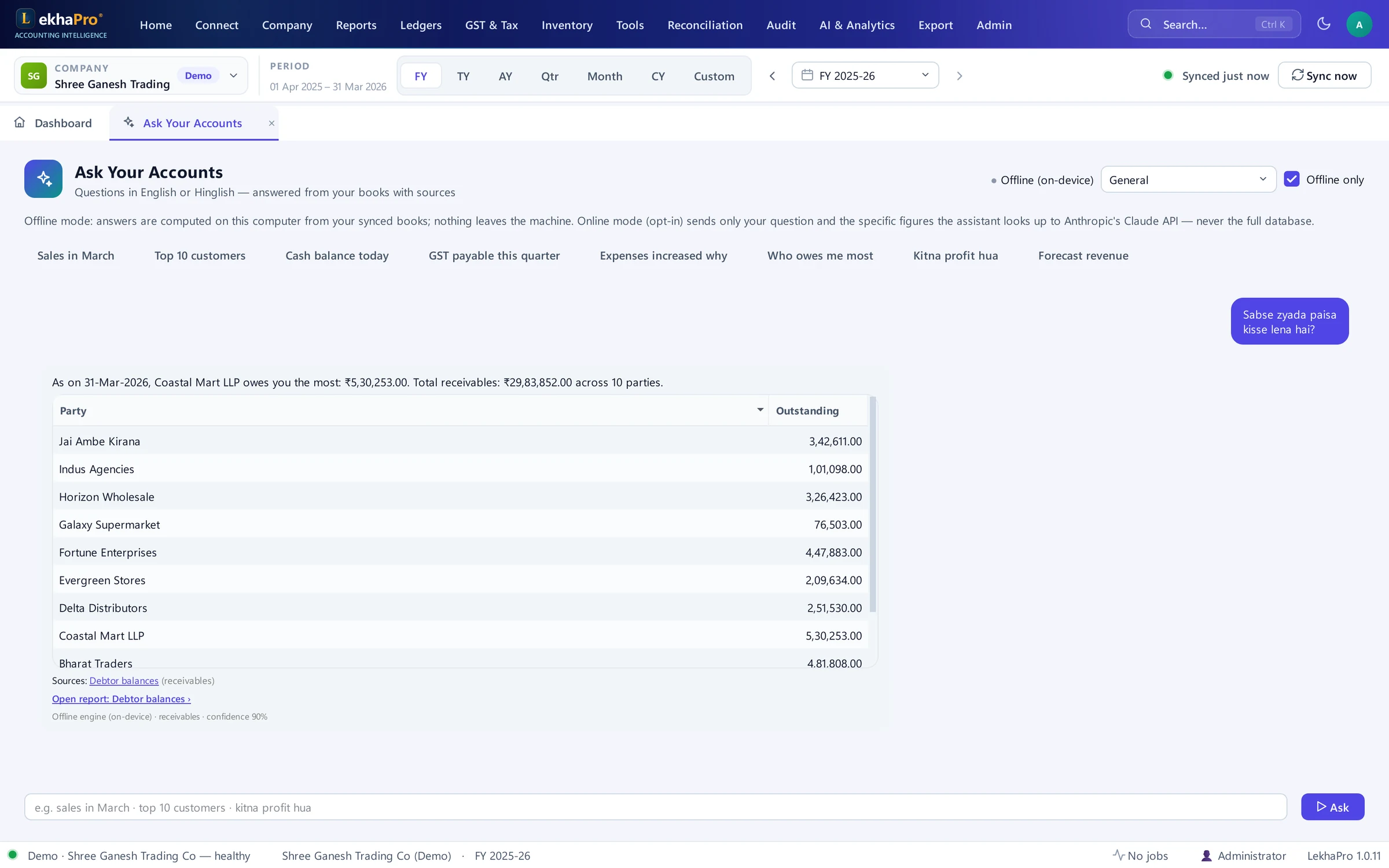
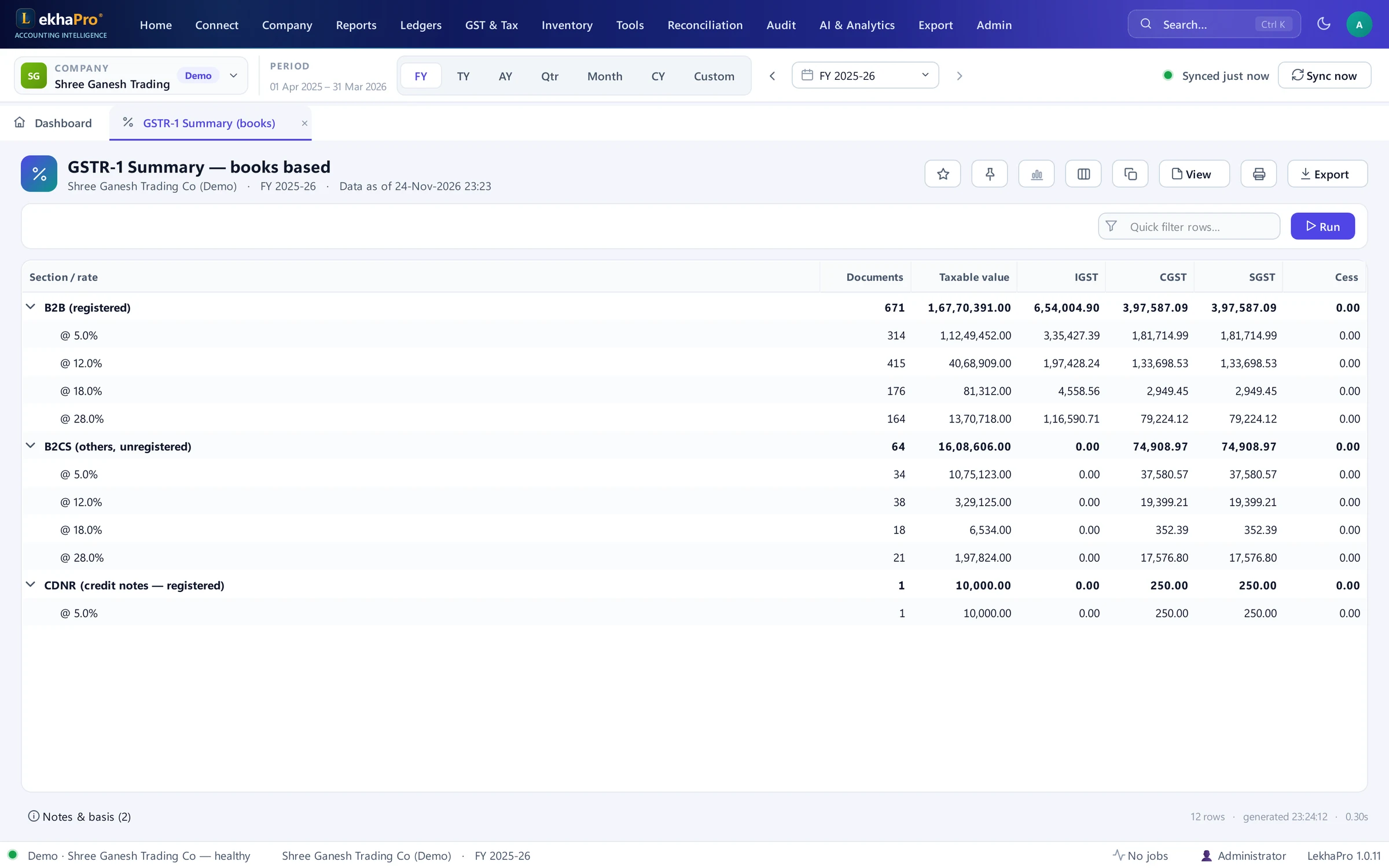
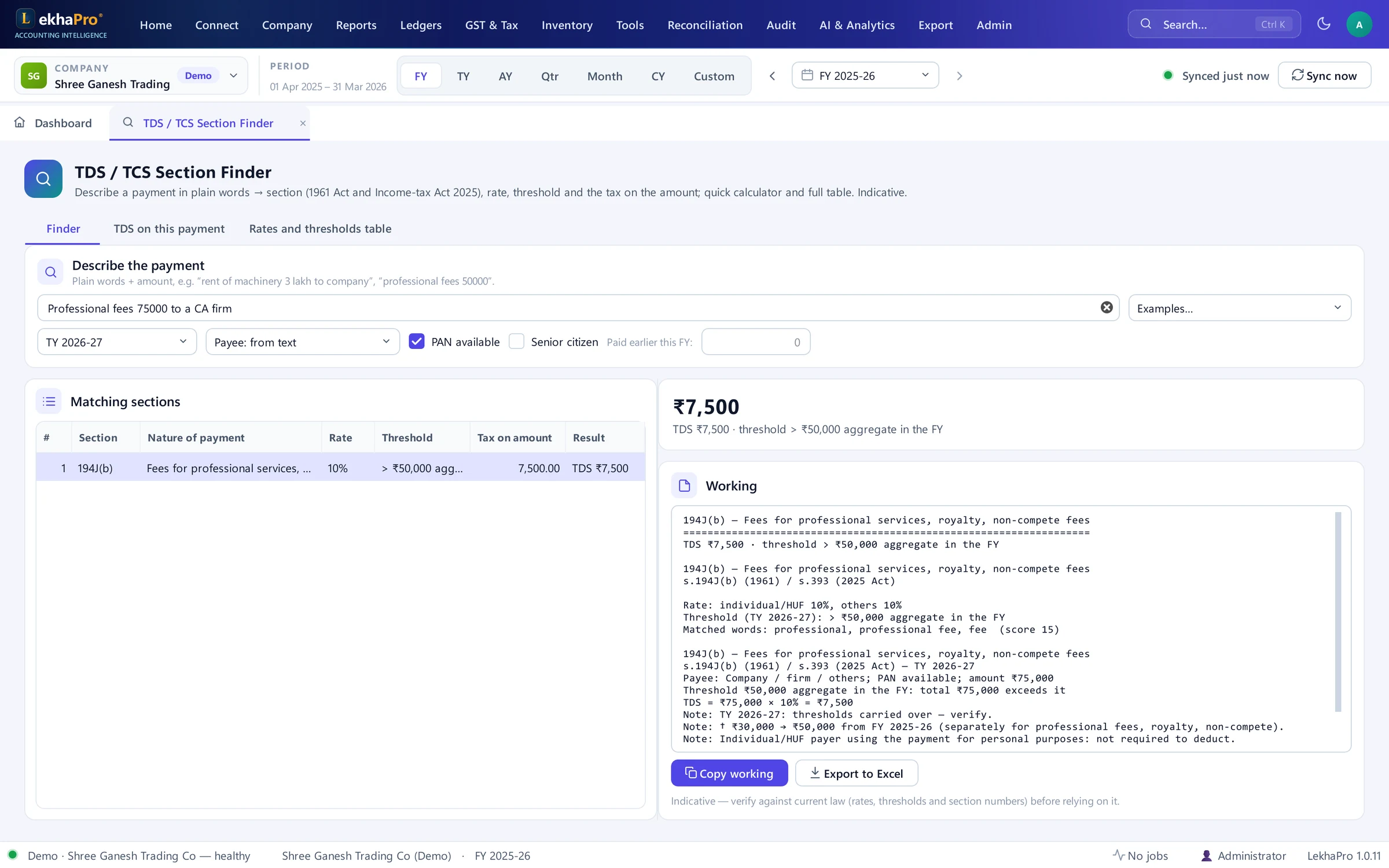
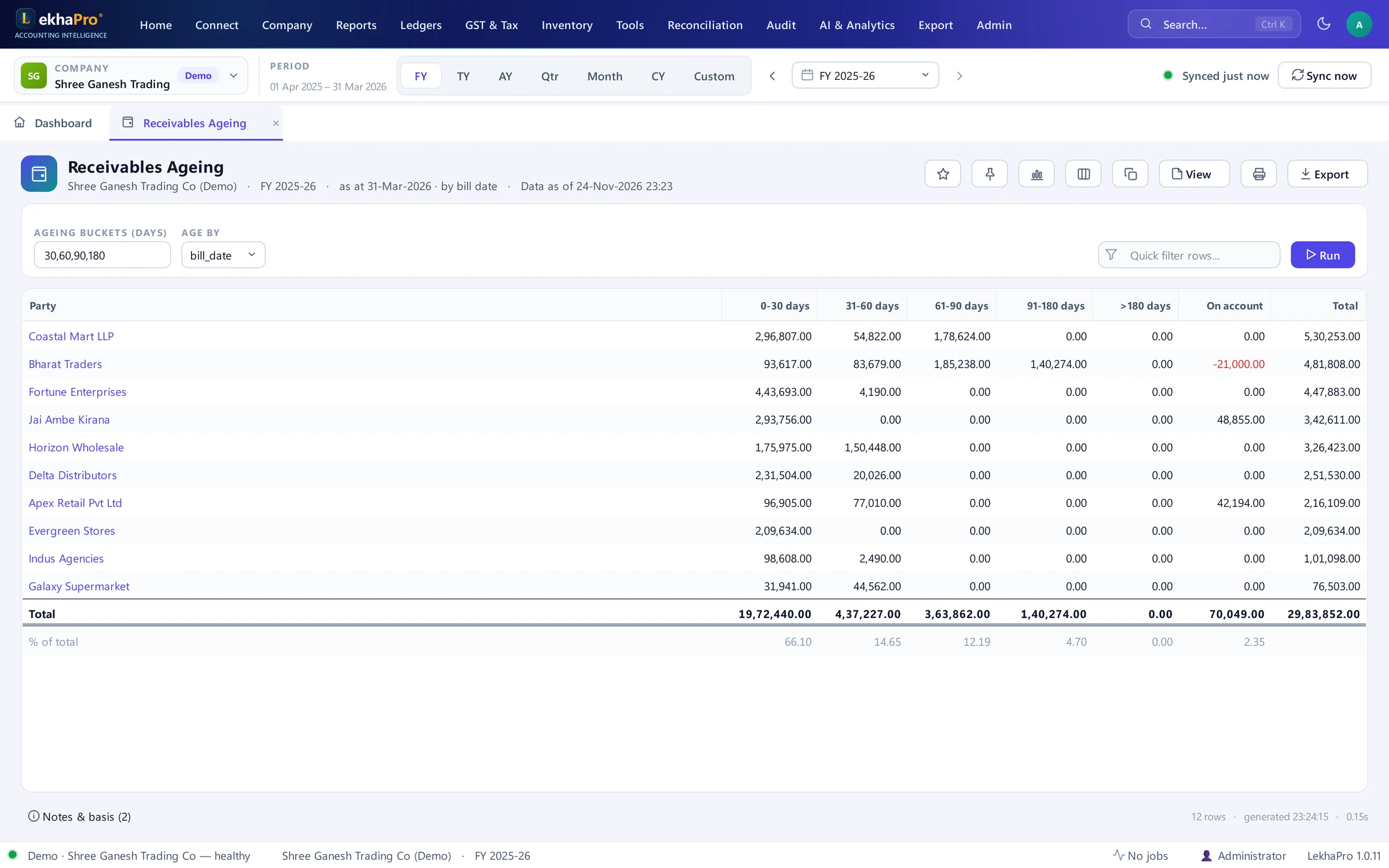
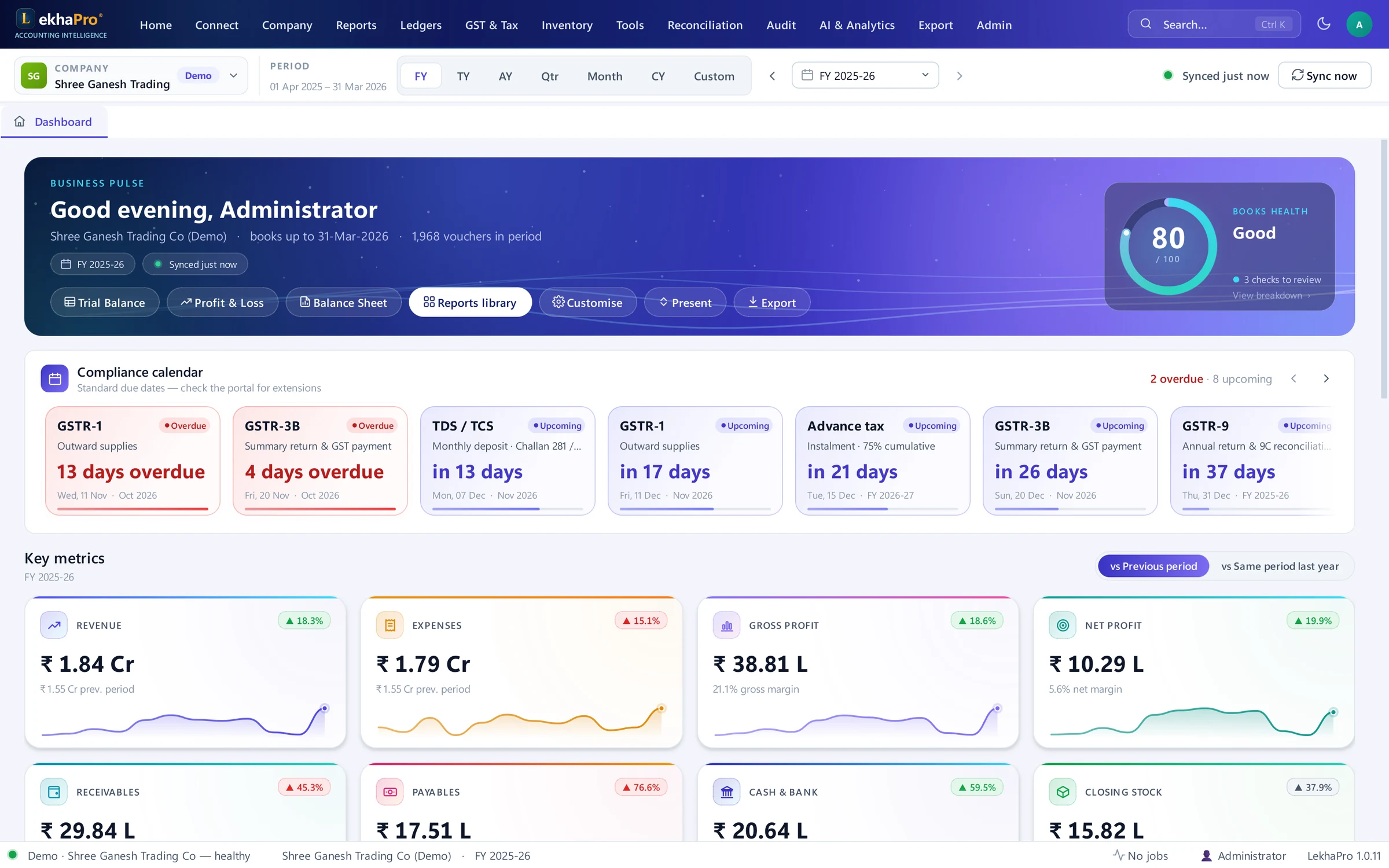
DashboardLekhaPro dashboard with business pulse, compliance calendar and key metrics
Questions
Schedule III, GSTR-2B, BUSY, MARG and audit
How do I prepare Schedule III statements from Tally?
Connect the Tally company, choose the year and open the Schedule III Balance Sheet or Profit and Loss. LekhaPro maps ledgers to Schedule III lines, adds previous-year figures, notes, ageing and ratios, and lets you change the mapping and layout. Export to PDF, Word or Excel after your review.
Statements follow Division I of Schedule III. Year-end entries are kept beside the books.
How does GSTR-2B reconciliation work?
Import the GSTR-2B file downloaded from the GST portal as JSON, Excel or ZIP. LekhaPro compares it with purchases in the books by GSTIN, invoice number, date and value. It lists matched, different, missing and duplicate invoices, finds numbers typed differently, and shows the ITC at risk.
It also works for GSTR-2A and for filed GSTR-1 against sales, with an IMS worksheet and supplier follow-up letters.
Can it read BUSY, MARG and EasySol as well as Tally?
Yes. LekhaPro reads TallyPrime and Tally.ERP 9, BUSY, MARG ERP and EasySol directly, without exporting first. Any other software can come in through Excel, CSV, ODS, XML or JSON files, or a two-year trial balance. All of them use the same report library, so your working method stays the same.
Tally can be read live or from its data folder with Tally closed. Product names belong to their owners and are used only to say what LekhaPro can read.
Does LekhaPro file GST returns by itself?
No. LekhaPro makes files from the books and checks them before export: GSTR-1 JSON and Offline Tool Excel, GSTR-3B JSON, e-invoice and e-way bill bulk files and more. You review each file, upload it to the portal and file the return there with your own login.
Can it read a Tally company locked with TallyVault?
Only with the client's help. A TallyVault company is encrypted, and LekhaPro does not guess or break its password. The client can open it in Tally and let LekhaPro read it live, or remove the vault in Tally. Either way, the password is typed only into Tally itself.
Which audit checks does LekhaPro run?
LekhaPro runs an Exception Library of 128 rules on the books, with limits that you can tune for each company. Checks cover cash limits under sections 40A(3) and 269ST, duplicates, back-dated entries and Benford analysis. Sampling, a CARO 2020 builder and an anomaly ranking are included. Results need your review.
What are the CA tools?
There are 21 CA tools and 4 document tools in the desktop app. They include a PDF toolkit and editor, interest, late-fee and capital gains calculators, 26AS and AIS matching, registers for notices, UDIN and DSC, and certificates and letters. The file-based tools work only on the files that you choose.
See it on your own client's books
Ask for a personalised demo for your practice or finance team.