Features
One workflow from books to reports
Work of a CA, auditor or finance team in one Windows desktop application, with AI that answers from the books.
- 225225ready reports
- 128128audit exception rules
- 2121CA tools + 4 document tools
- 88AI personas
Feature groups
Connect
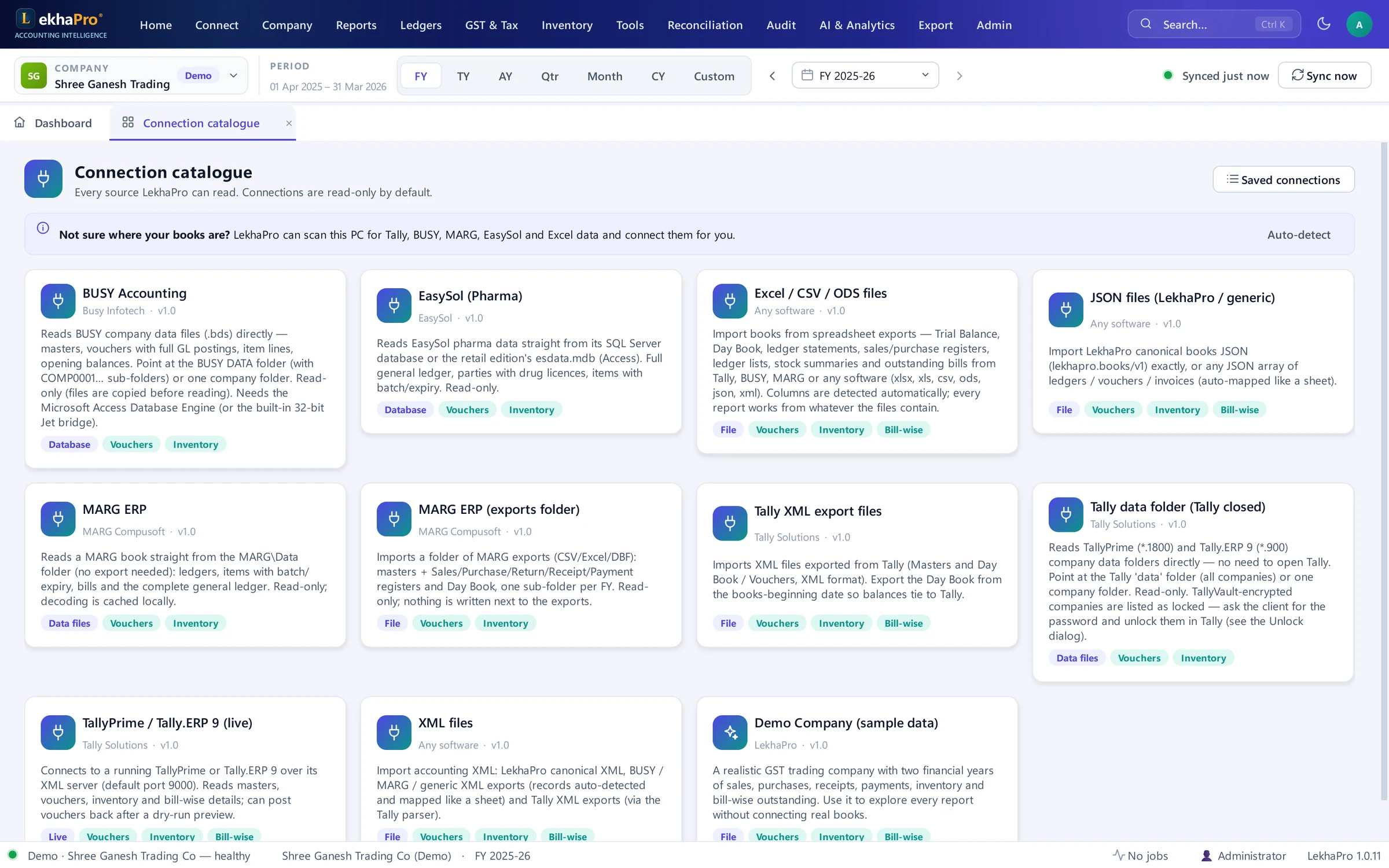
Auto-detect, live or file. Any company, any period.
- Finds accounting software and company data on this PC
- TallyPrime / Tally.ERP 9 live, or the data folder with Tally closed
- BUSY, MARG ERP and EasySol without exporting first
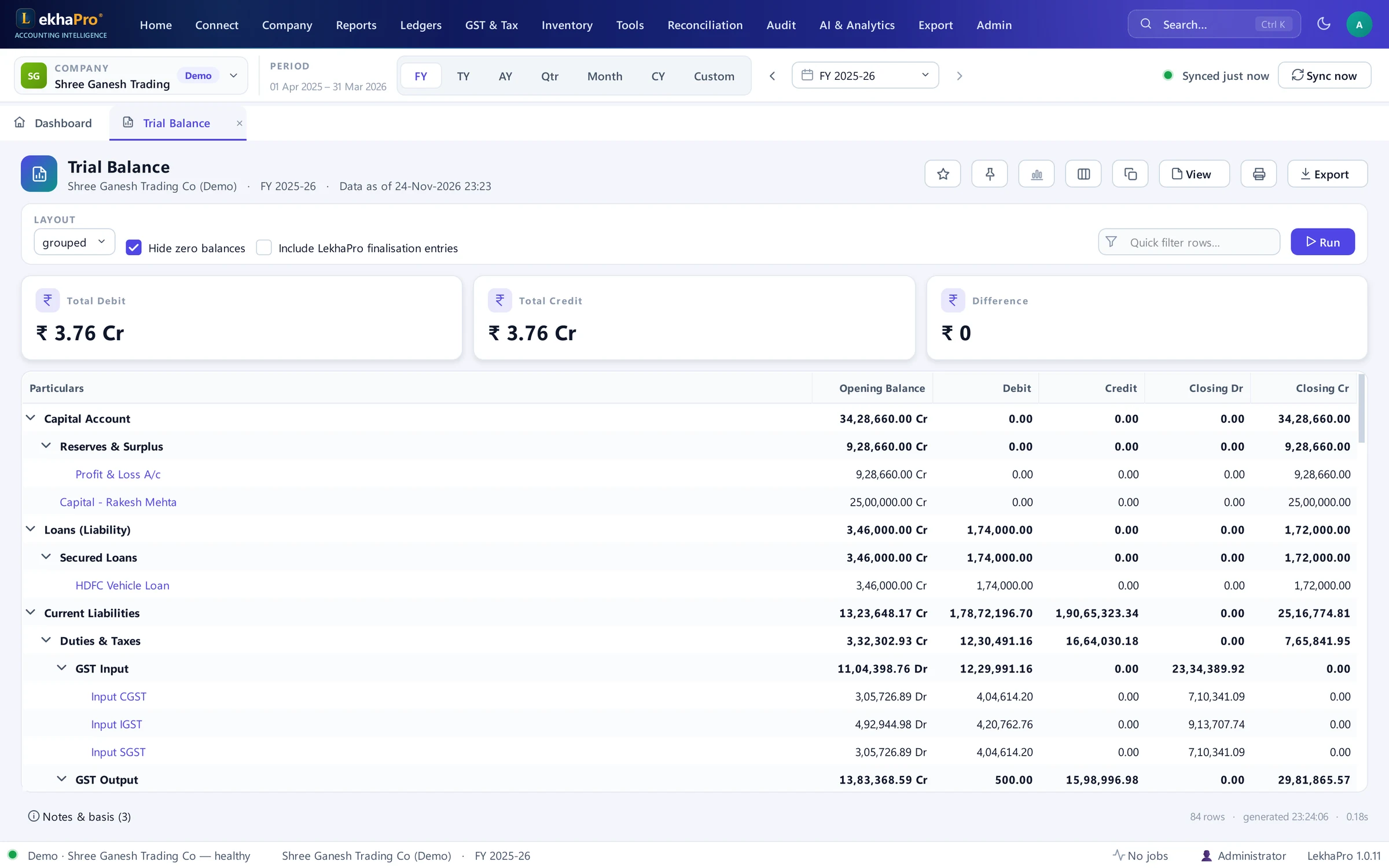
- Two-year trial balance import for any other software
- FY, AY, TY, quarter, month or custom range
Statements & Books
Schedule III, notes, designer and multi-year comparatives.
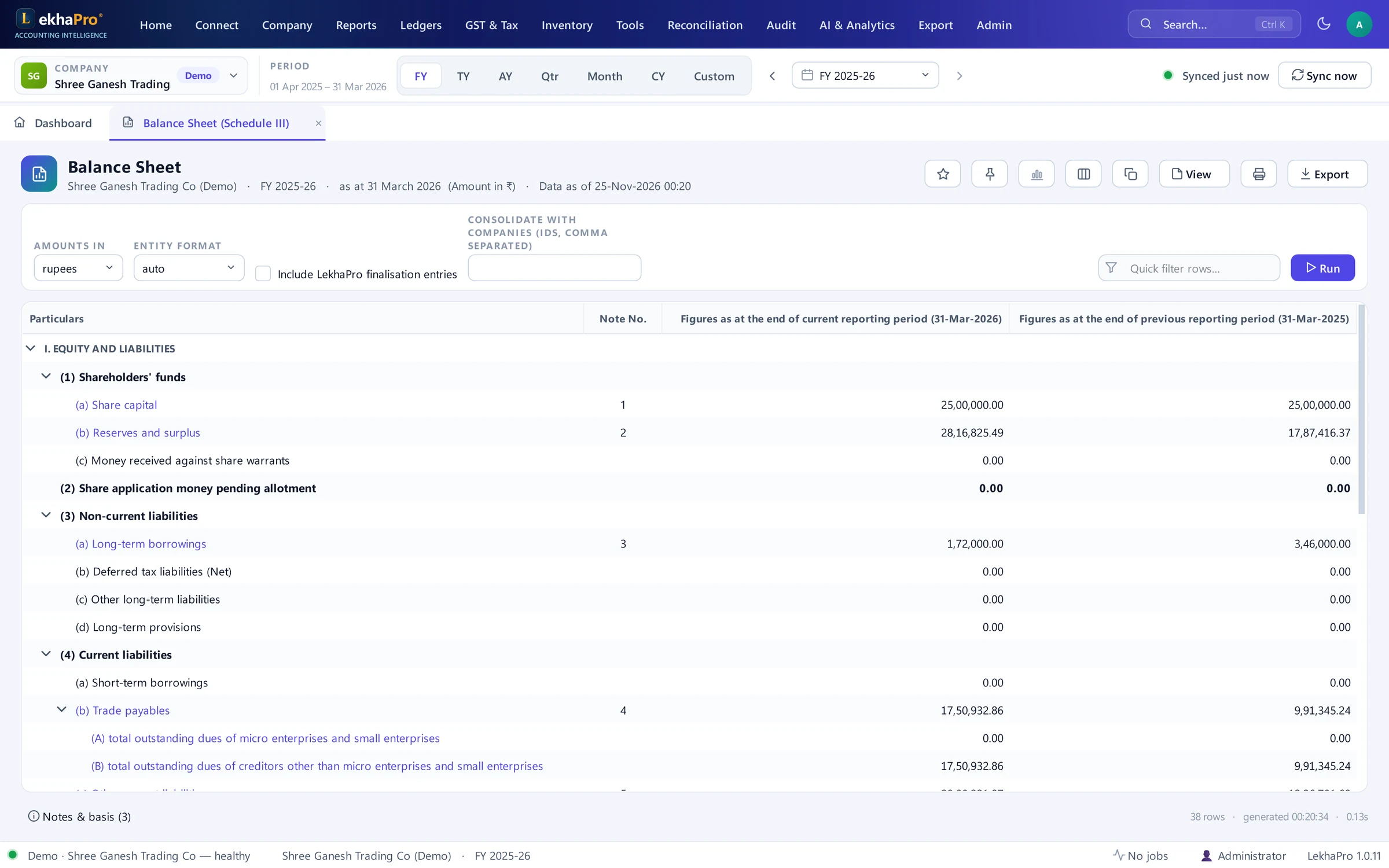
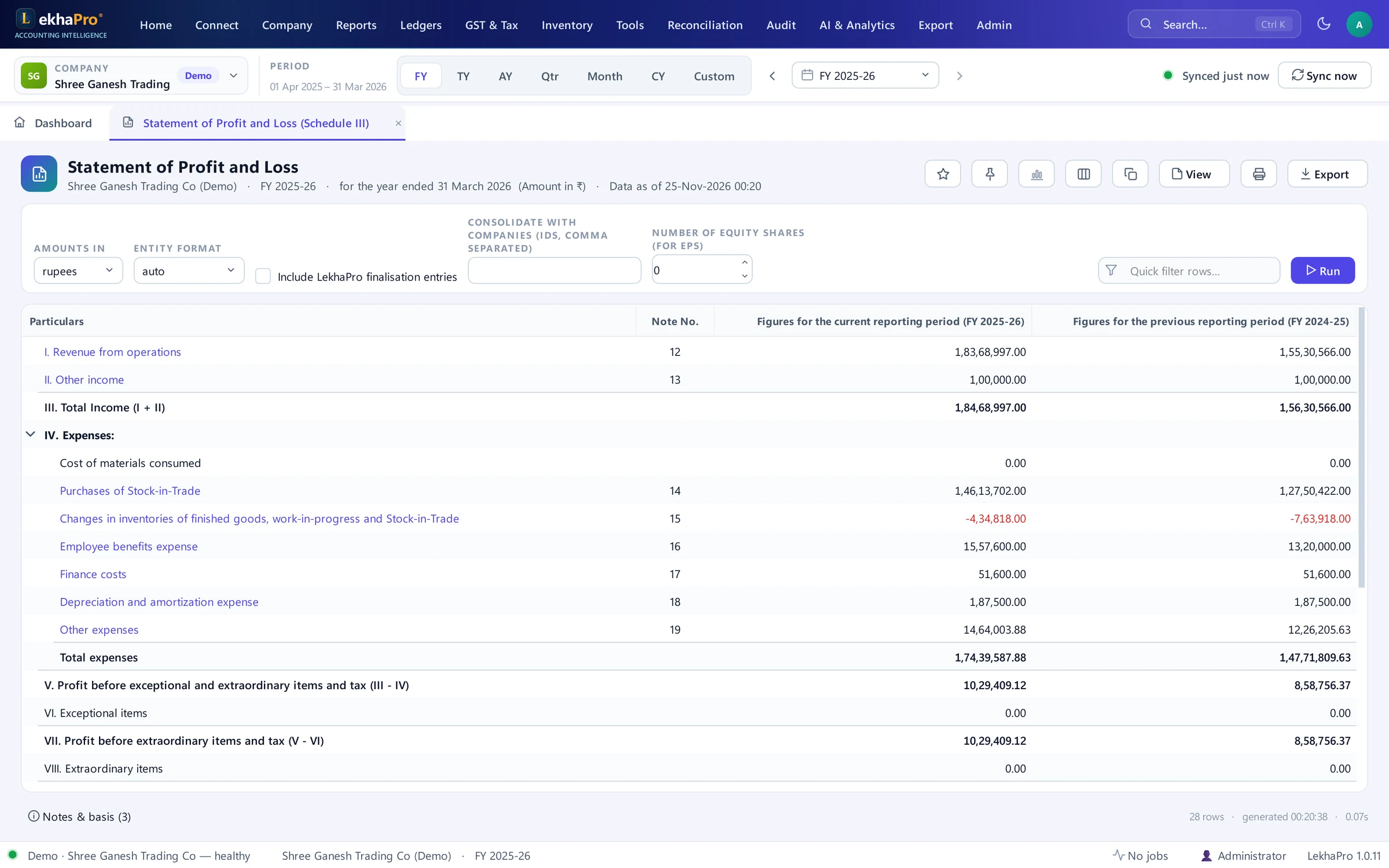
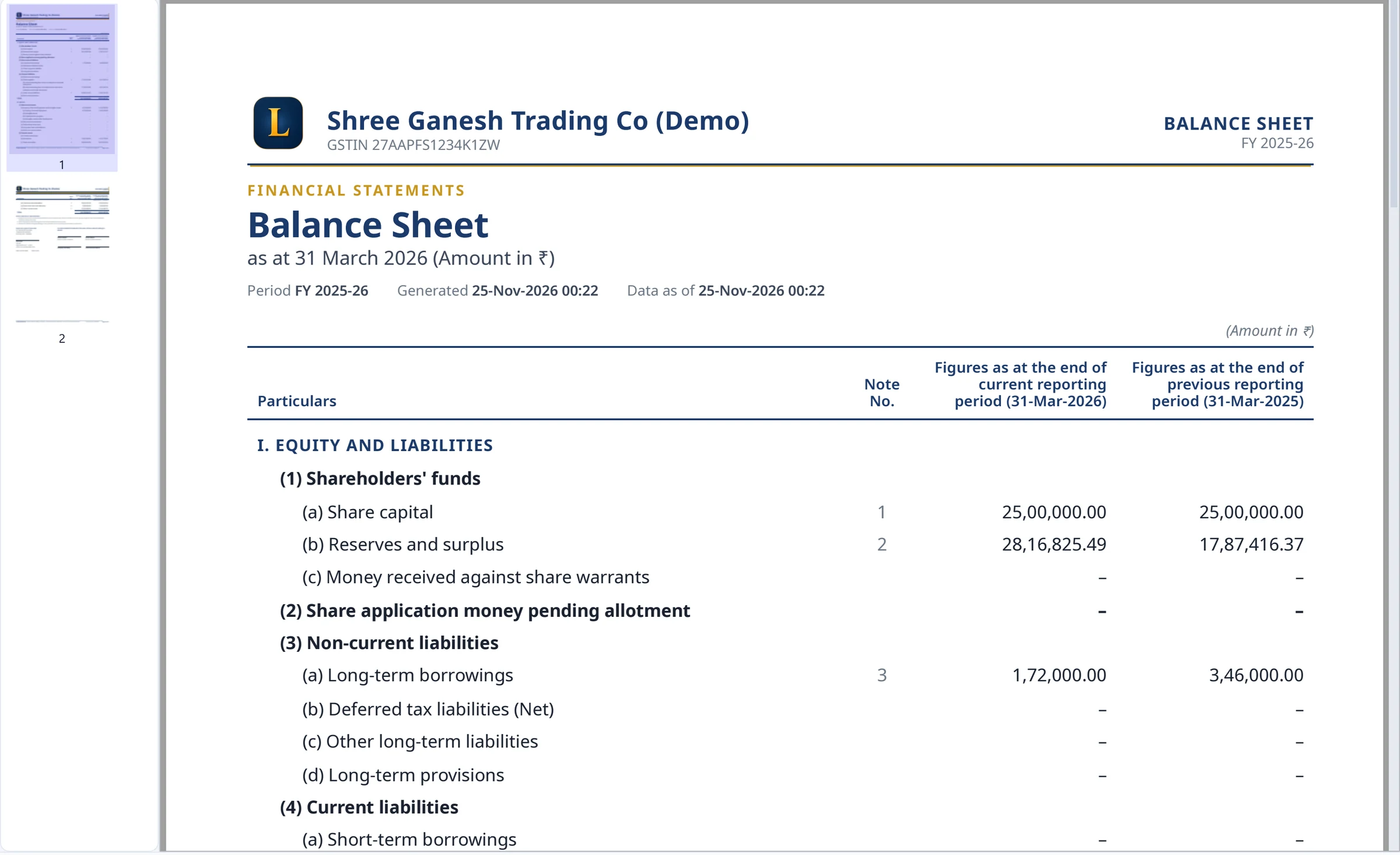
- Schedule III Balance Sheet and P&L with the previous year
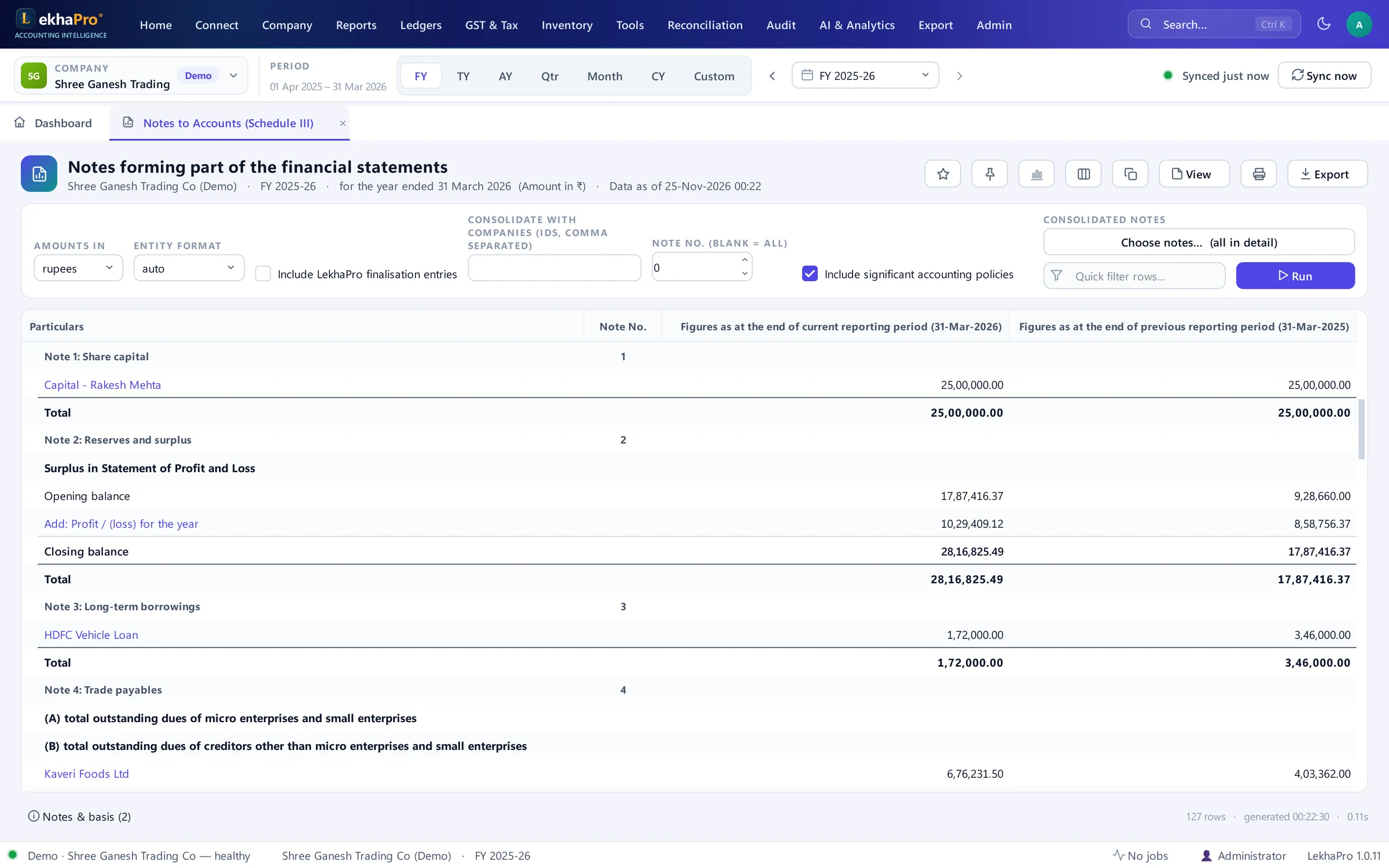
- Notes to accounts, ageing, MSME disclosure and ratios
- Cash flow (indirect and direct) and funds flow
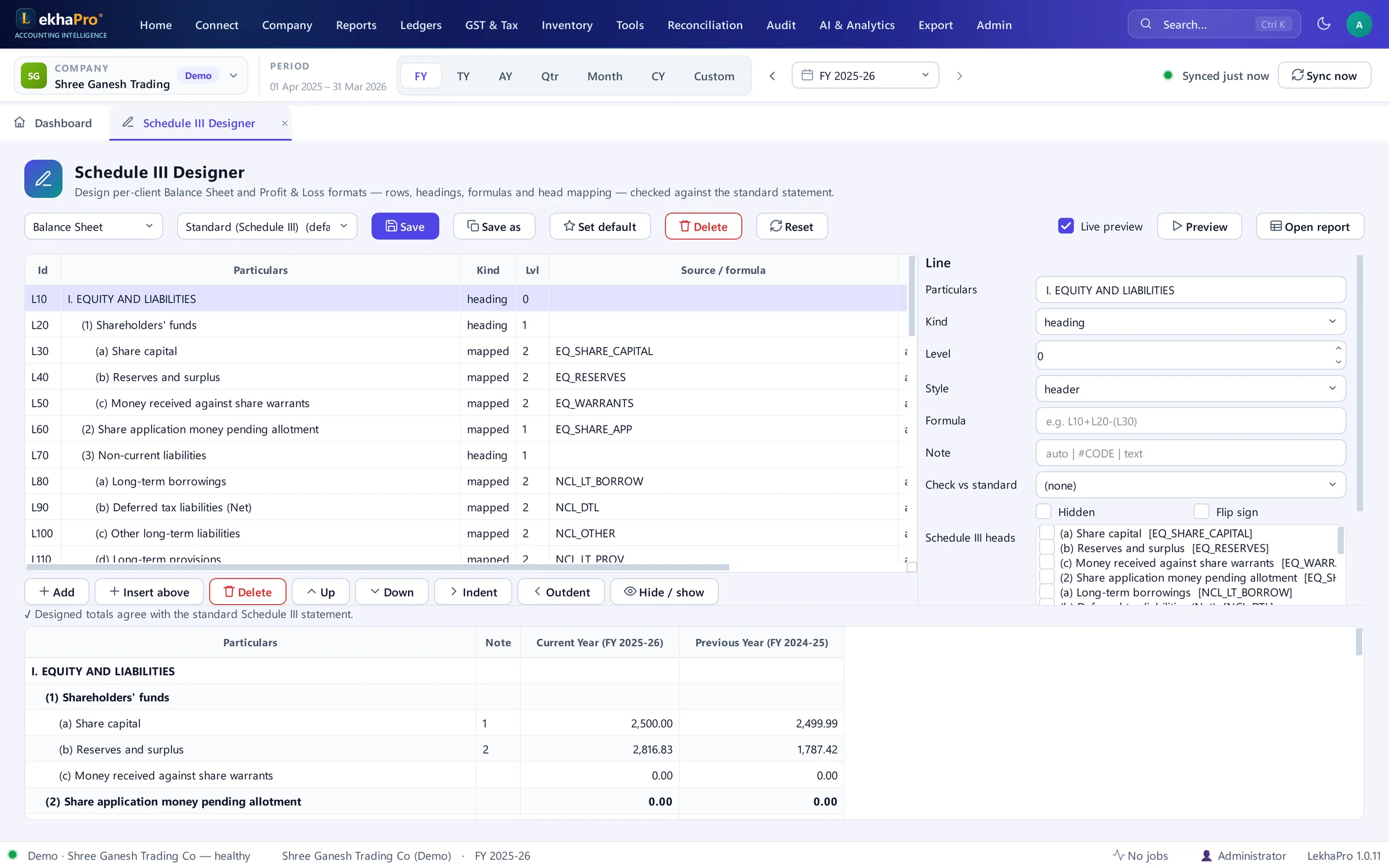
- Schedule III Designer with a live preview per client
- Multi-year analysis: trends, growth and ratios
GST & Portal Files
GSTR-1, 3B, 9, e-invoice, TDS and more, checked first.
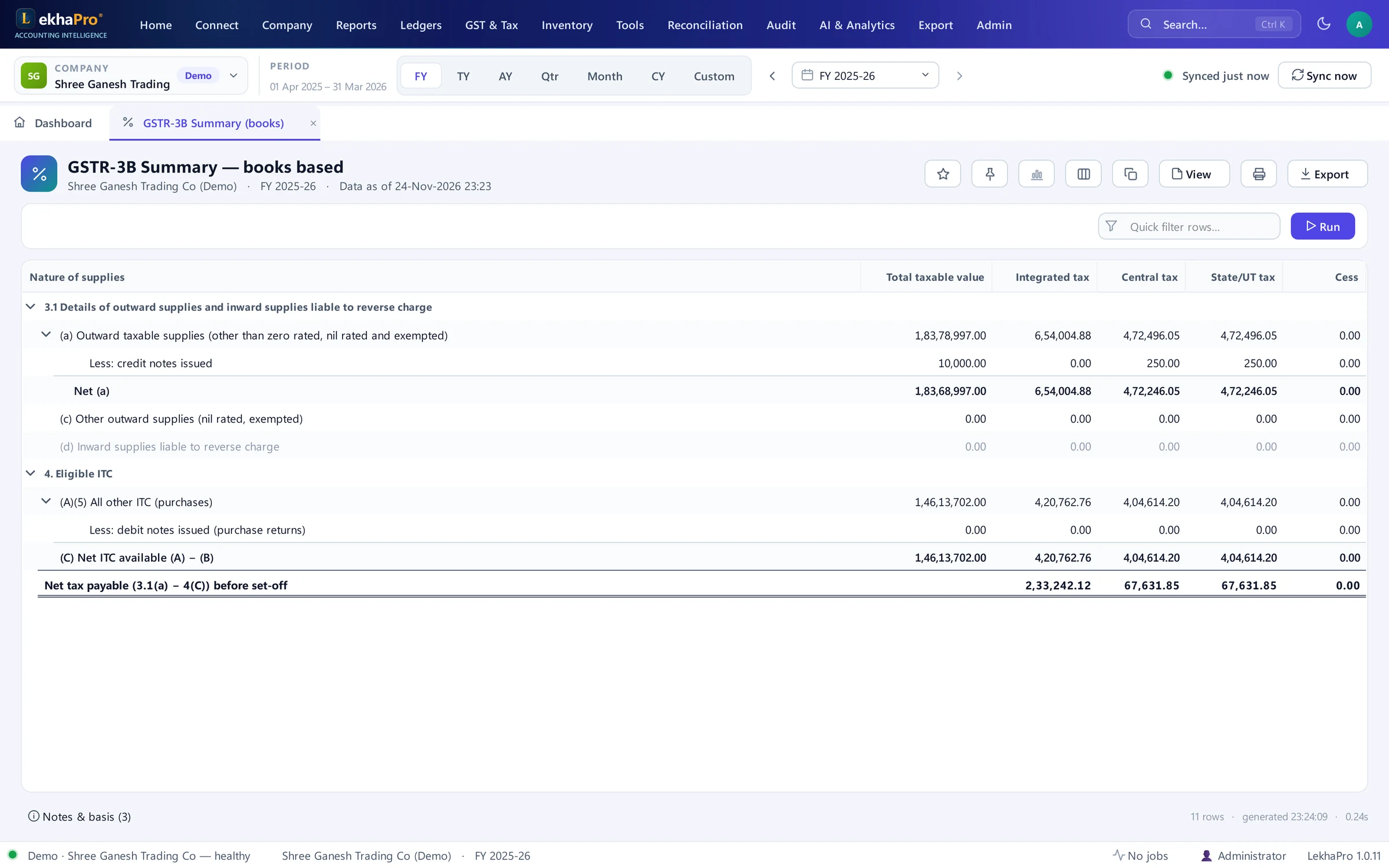
- GSTR-1 portal JSON and Offline Tool Excel, GSTR-3B JSON
- GSTR-9 annual return and 9C worksheet
- E-invoice and e-way bill bulk files
- TDS 26Q / 24Q statement data, Form 3CD clause data, ITR Part A-BS / P&L
- AOC-4 draft, MSME Form-1 and compliance calendar
Reconciliation
Bank, GSTR-2A / 2B, IMS and GSTR-1.
- Bank reconciliation with auto-match and BRS
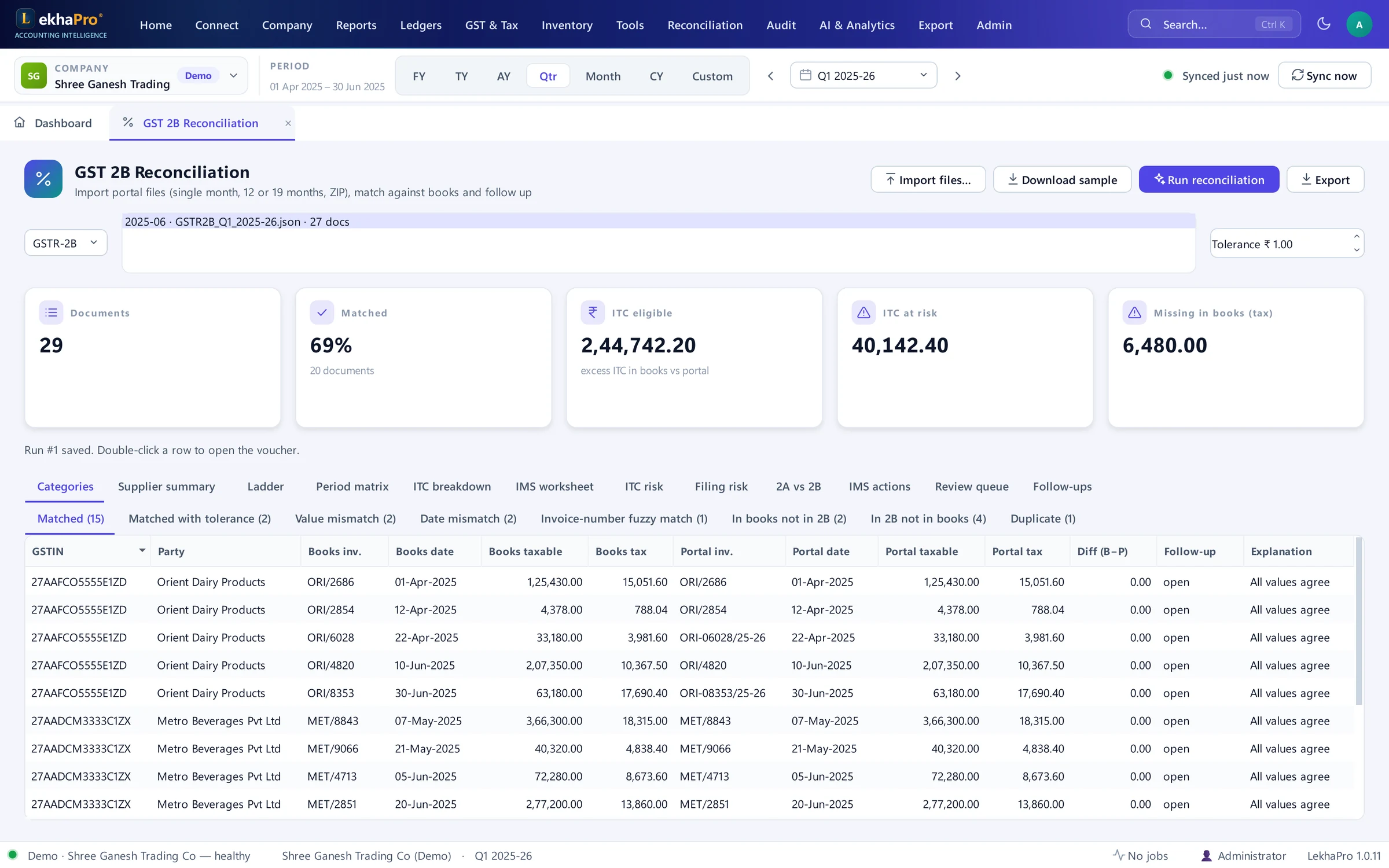
- Books vs GSTR-2B / 2A with fuzzy invoice numbers
- IMS worksheet: accept, reject or pending
- Filed GSTR-1 compared with the sales books
- ITC at risk and supplier follow-up letters
Year-end & Assets
Finalisation entries, fixed asset register and tax.
- Finalisation entries kept outside the source books, maker-checker with two or more users
- Year-end readiness checklist
- Fixed Asset Register reconciled to the ledger
- Companies Act and Income-tax depreciation
- Salary tax (old vs new regime), budgets and forecast
Audit
128 exception rules, sampling, CARO and engagements.
- Exception Library of 128 rules, tuned per company
- 40A(3), 269ST, duplicates, back-dated entries, Benford
- Sampling rules (SA 530) and differences (SA 450)
- CARO 2020 builder and observations register
- Anomaly Centre ranks unusual transactions
Documents & OCR
Bills to voucher drafts, read on your own PC.
- Offline OCR for invoices, bills and receipts
- GSTIN, invoice number, date, value and tax extracted
- Confidence score and position on the page
- Duplicate-bill check before booking
- Approved drafts to Tally XML or Excel
AI & Analytics
Ask your accounts, forecasts, MIS and Report Studio.
- Answers from the company's own books, with sources
- Eight personas, with full effect when online AI is on
- Daily briefing, forecasts and what-if scenarios
- Pivot tables and charts in Report Studio
- Built-in AI on your PC; online AI is optional and needs your consent and API key
CA Tools
21 CA tools + 4 document tools.
- PDF toolkit and PDF editor
- Interest, late-fee and capital gains calculators
- 26AS / AIS and GSTR-2B matchers
- Notices, UDIN, DSC and fee billing registers
- Certificates, letters and agreement summaries
Reports
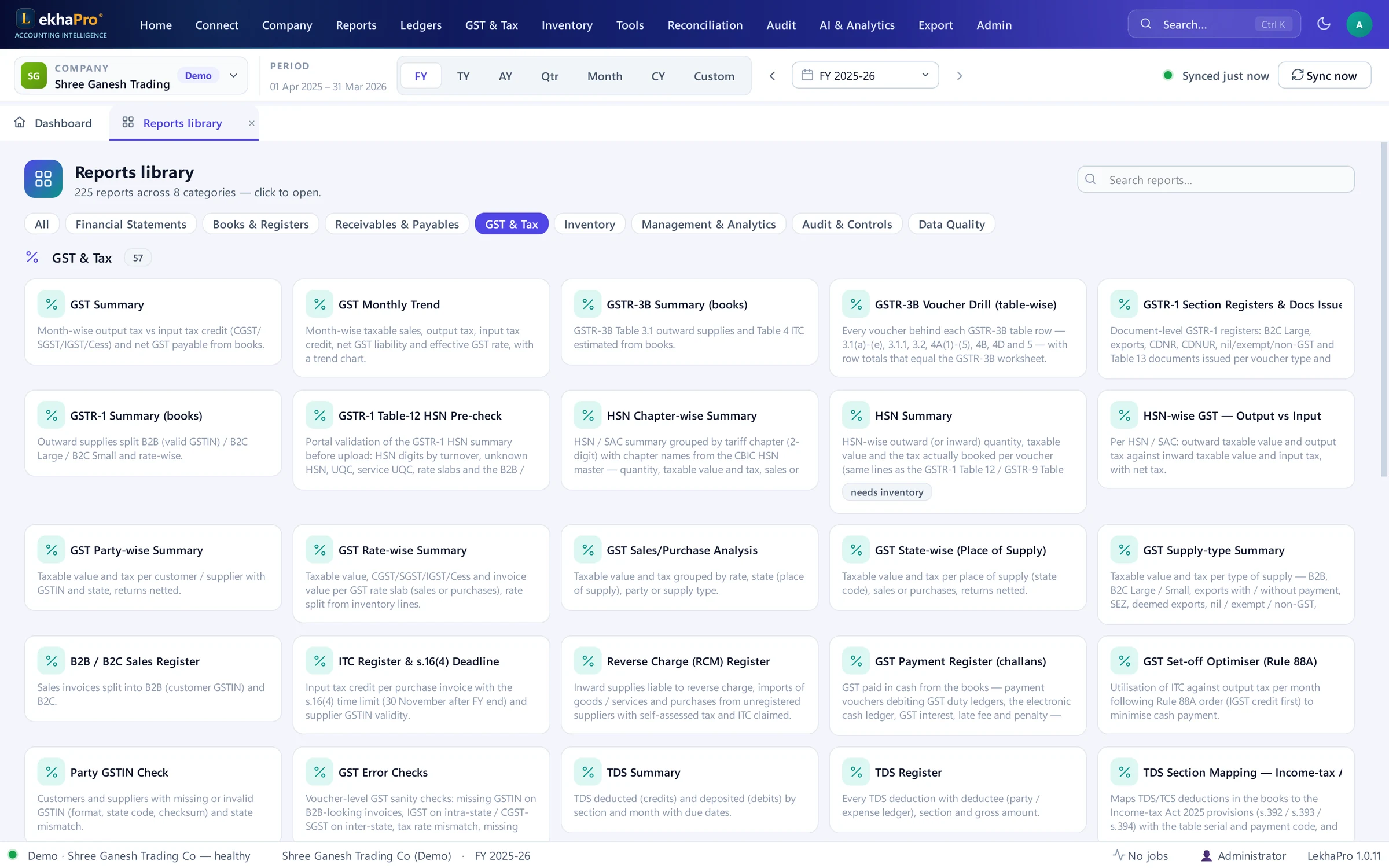
225 ready reports
No report to design and no template to set up. Pick the company and period and open any report.
37 reports in Management & Analytics
Management & Analytics 37
Dashboard KPIs
Headline KPIs for the period with prior-period comparison (used by the dashboard).
Executive Summary
One-page narrative summary of performance, position and alerts for the period.
Daily Briefing
Activity on the last day of the period (or latest data day): sales, receipts, payments, cash position and bills falling due.
MIS KPI Pack
Twelve standard KPIs with formulas: revenue, EBIT, EBITDA, cash, NWC, GWC, DSO, DSI, DPO, CCC, ROE, ROCE — current vs previous.
MIS P&L (staged)
Management P&L: Net Sales → Gross Profit → PBIDT → profit after interest before depreciation → Net Profit, expenses grouped Manufacturing / Personnel / Admin / Selling; Current month, previous month, variance, YTD and previous YTD.
Receipts & Payments (MIS Cash Flow)
Operational cash statement: opening cash & bank, inflows (collections, other receipts, loans, capital), outflows by head (salary, statutory dues, creditors, advances, loans, finance charges, routine expenses) and the closing balance broken up into cash in hand and each bank.
Break-even Analysis
Cost-volume-profit: variable vs fixed costs, contribution, P/V ratio, break-even sales and margin of safety, with a monthly table.
Monthly Trend
Sales, purchases, expenses, receipts and payments per month with chart.
Ratio Analysis
Liquidity, leverage, profitability and efficiency ratios vs previous period ('n/a' for zero denominators).
Top Customers
Customers by sales with share, Pareto class and concentration (HHI).
Top Suppliers
Suppliers by purchases with share, Pareto class and concentration (HHI).
Sales / Purchase Analysis
Taxable sales (or purchases), net of returns, by party, item, item group, state, month, day or weekday.
Area-wise Sales
Sales by state, city or party ledger group: customers, invoices, taxable value, tax, invoice value and share.
Party-wise Sales / Purchases
Party-wise bills, quantity, taxable value, tax, invoice value, returns (credit / debit notes), net and share; optional area filter.
Concentration Risk (Pareto)
Every customer, item or vendor ranked by value with share, cumulative % (Pareto), ABC class and the Herfindahl-Hirschman concentration index.
Inactive Customers
Customers with no sale for more than N days before period end, with last sale and balance.
Customer-wise Gross Profit
Revenue, cost of goods sold (weighted-average item cost), gross profit and margin % by customer.
Expense Analysis
Expenses by ledger with share of total, monthly average and month-on-month change.
Revenue Leaks
One roll-up of money left on the table: sales below cost, unbilled delivery challans, unapplied (on-account) receipts and overdue interest not charged — each group drills to its source report.
Year-on-Year Growth
Key figures for the period vs the same period last year, with growth %.
Working Capital
Current assets and liabilities at period end vs previous, net working capital and cash conversion cycle (DSO + DIO − DPO).
Budget vs Actual
Actual P&L by ledger/group against the budget stored in settings (budget:<company_id> = {ledger_or_group: annual amount}).
Budget vs Actual — Monthly
Budget (LekhaPro Budgeting versions) vs actual by ledger / group and month with variance and %.
Rolling Forecast
Actuals to date plus budget / trend for the remaining months: full-year outlook vs budget.
Monthly Depreciation (MIS)
Schedule II depreciation per asset class per month for monthly MIS / management accounts.
Multi-Year Summary
Key performance and position KPIs side by side for up to 10 years (FY / TY), with CAGR, last-year growth and trend.
Revenue & Expense Forecast
Monthly forecast with an 80 % confidence band (Holt-Winters or WMA-trend, chosen by back-test).
Multi-Year Profit & Loss
Profit & Loss group-wise (or Schedule III) for up to 10 years with YoY growth and optional common-size % of revenue.
Cash-flow Forecast
Cash + bank projected from bill-wise receivables/payables, forecast business and recurring expenses.
Multi-Year Balance Sheet
Balance Sheet (Tally layout or Schedule III) as at each year end for up to 10 years, with YoY growth and optional common-size % of total assets.
Month-wise across Years
One row per month of the year and one column per year — sales, purchases, expenses, receipts, payments, net profit or GST output — for seasonal comparison (heatmap).
Ledger across Years
One ledger's opening, debit, credit and closing balance for every year.
Group across Years
One account group (all ledgers under it) — opening, debit, credit and closing per year.
Top Parties across Years
Top customers or suppliers for every year with share, rank change and CAGR (bar race).
Top Items across Years
Top stock items by sales (or purchases) value for every year with share, rank change and CAGR (bar race).
Ratios across Years
Liquidity, leverage, profitability and efficiency ratios for every year with trend arrows.
Multi-company Rollup
Headline figures for several remembered companies side by side (param: company ids, comma separated; blank = all synced companies).
Integrations
Works with the books you already keep
No migration. Your source books are never changed unless you approve a posting to Tally.
TallyPrime / Tally.ERP 9
Live or data folderReads a running Tally, or the company folder with Tally closed. Posts back only vouchers you approve after a preview.
BUSY
DirectReads a copy of BUSY data files: masters, vouchers and inventory.
MARG ERP
DirectReads the MARG data folder: masters, vouchers and stock.
EasySol
DirectReads accounting and inventory data from SQL Server or Access.
Excel / CSV / ODS / XML / JSON
File importTrial balance, day book or ledger export. Columns are mapped automatically and the mapping is saved.
Trial Balance import
Two-yearFor any other software: load current and previous year and go straight to reports.
Product names belong to their owners and are used only to say what LekhaPro can read.
Screens
Real screens, sample data
Click the screen in the laptop to see it in full size.
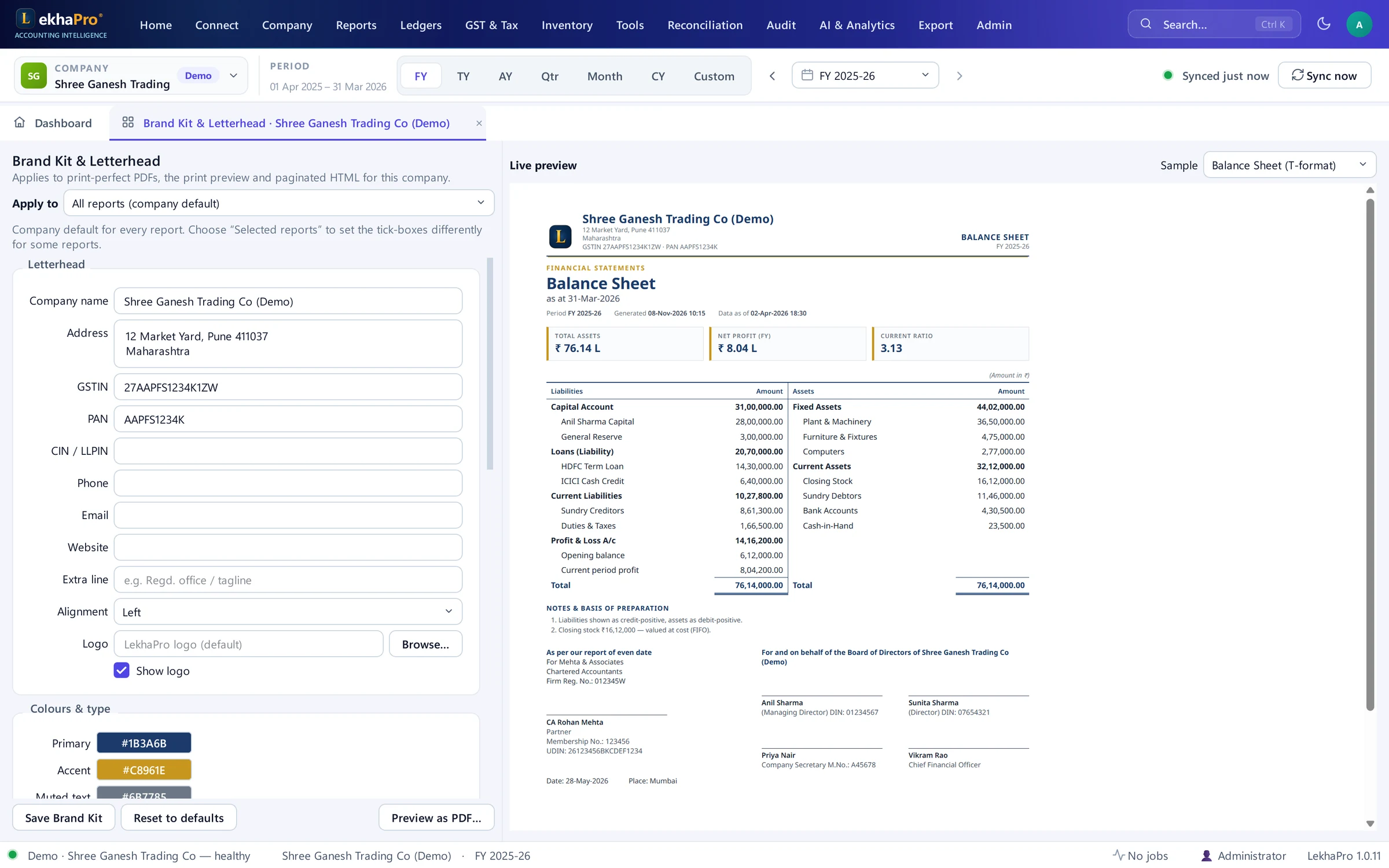
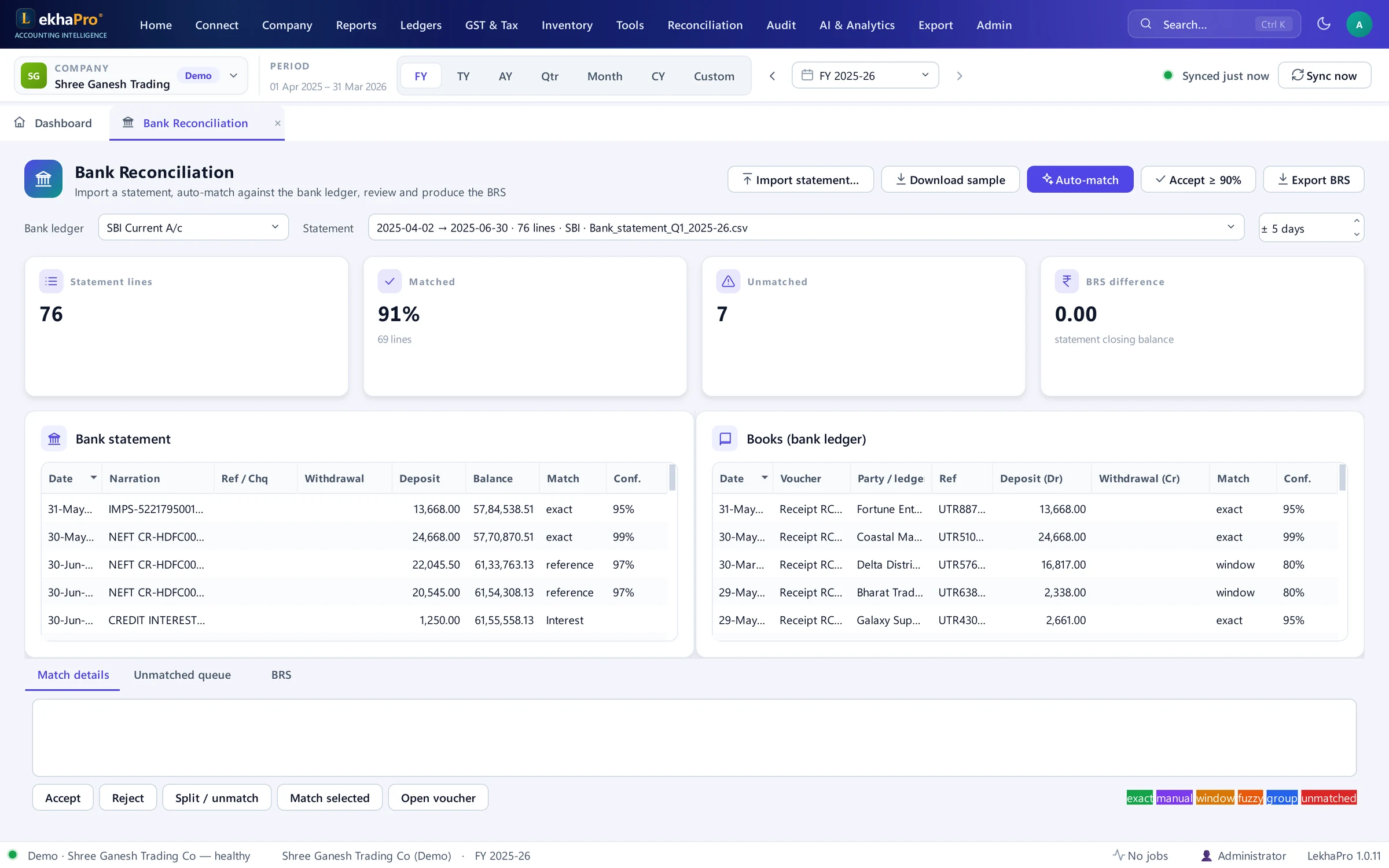
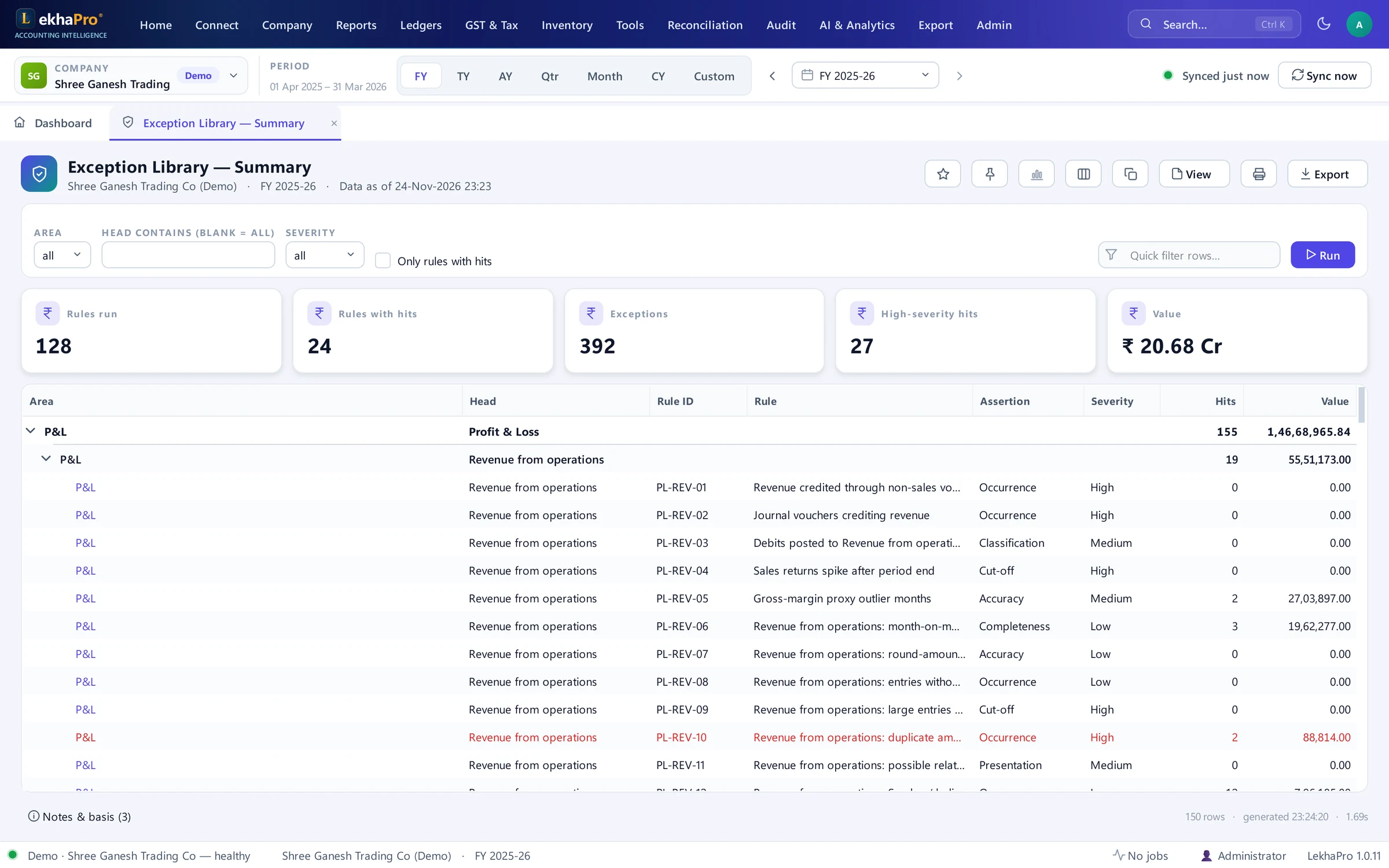
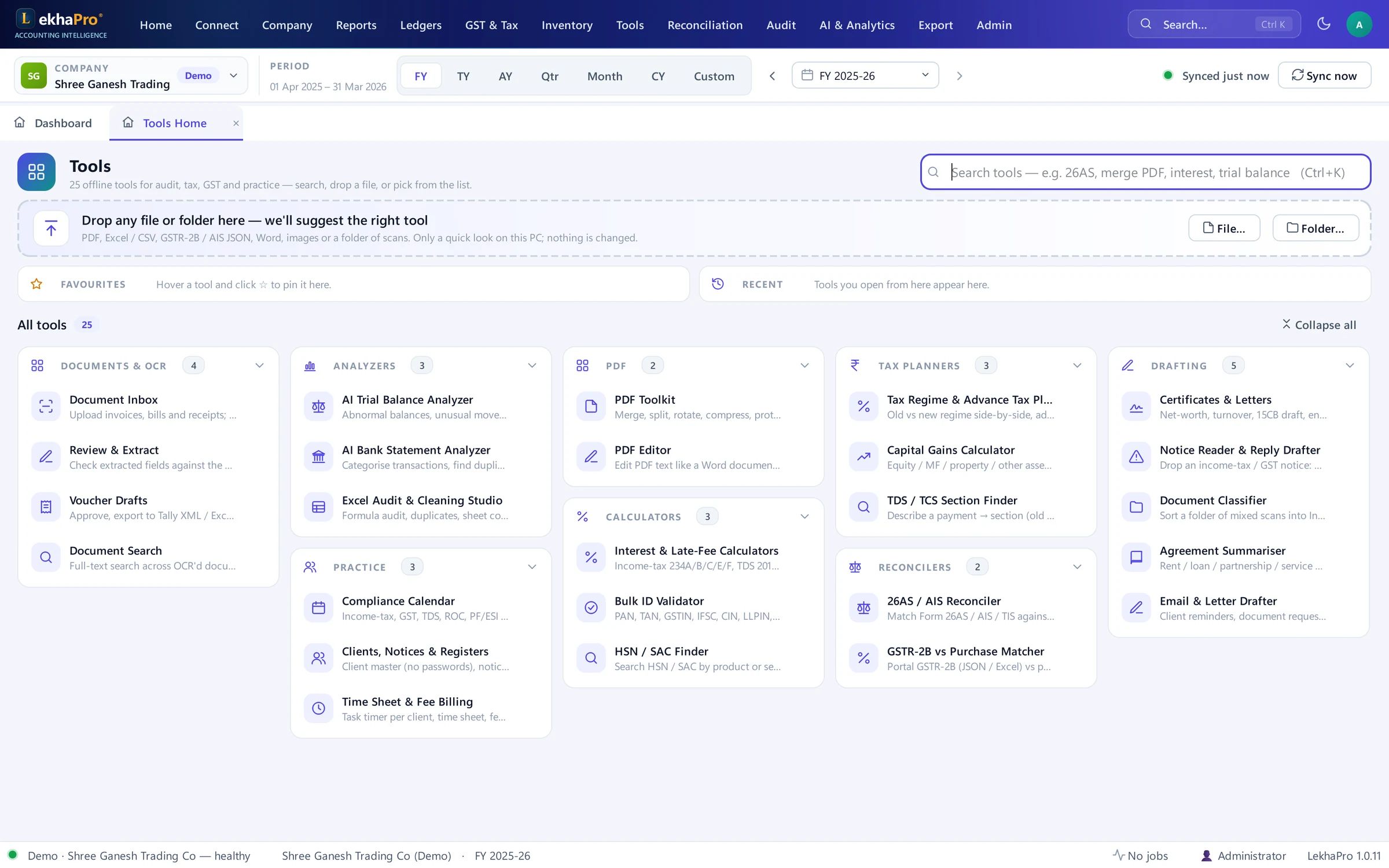
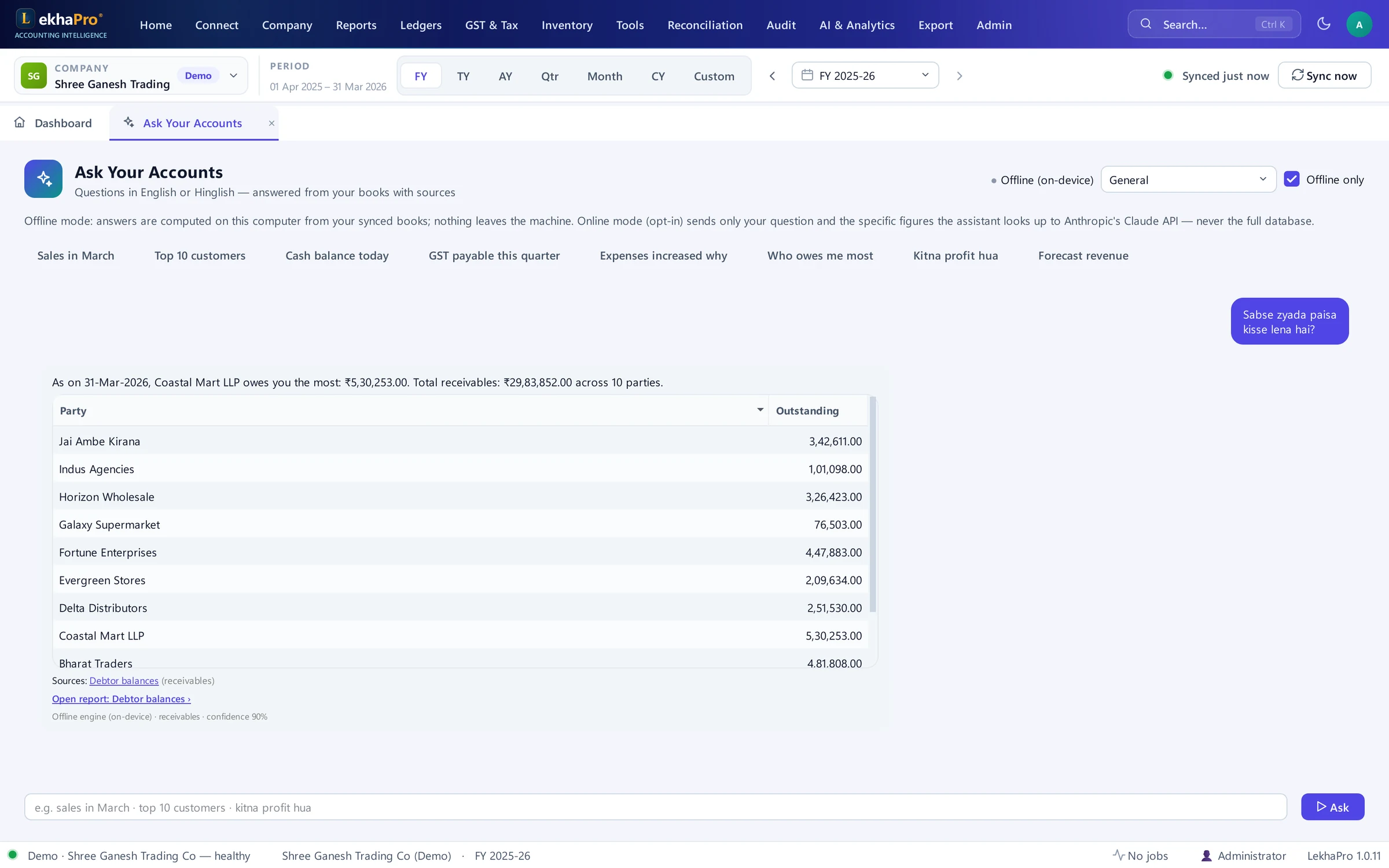
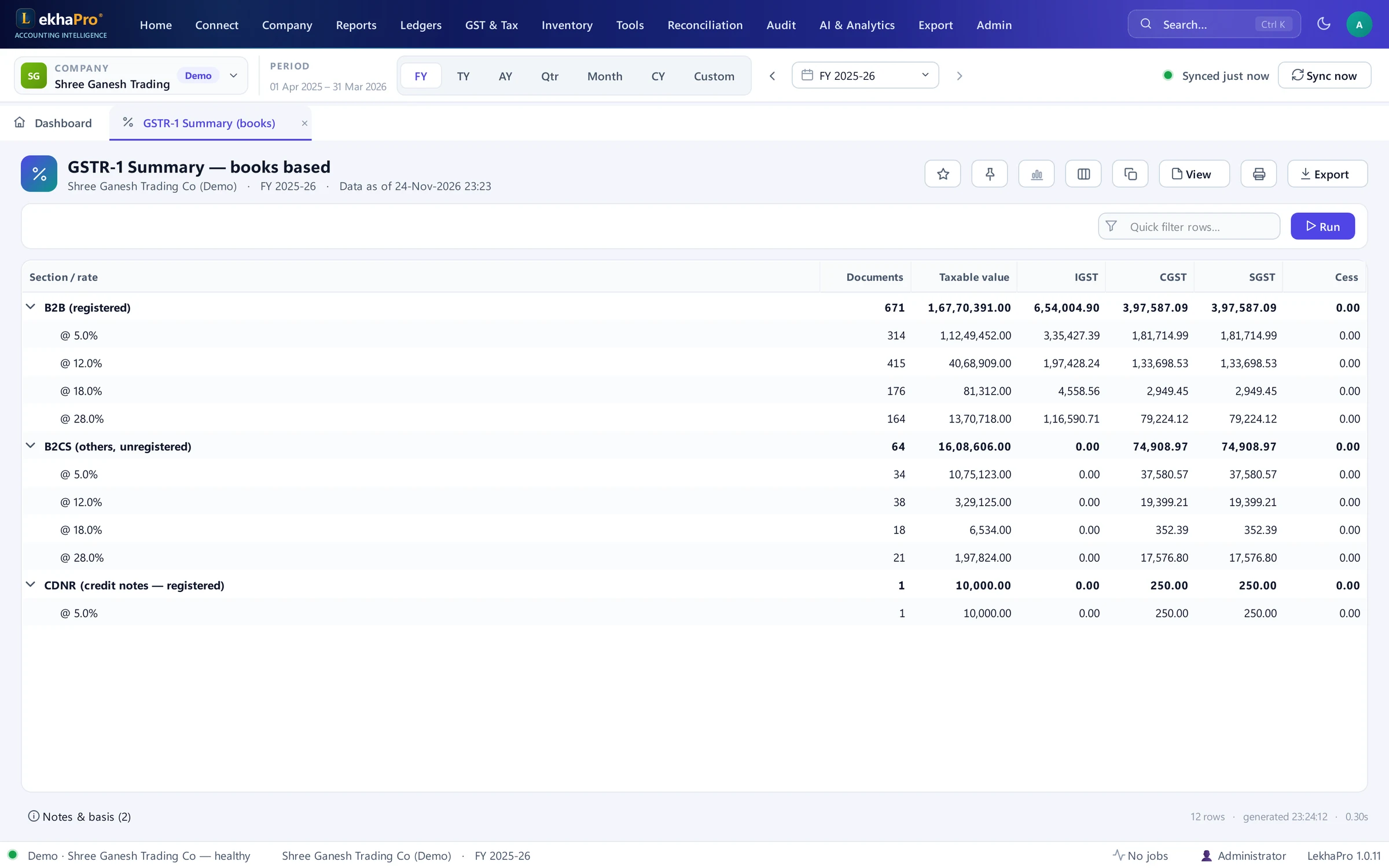
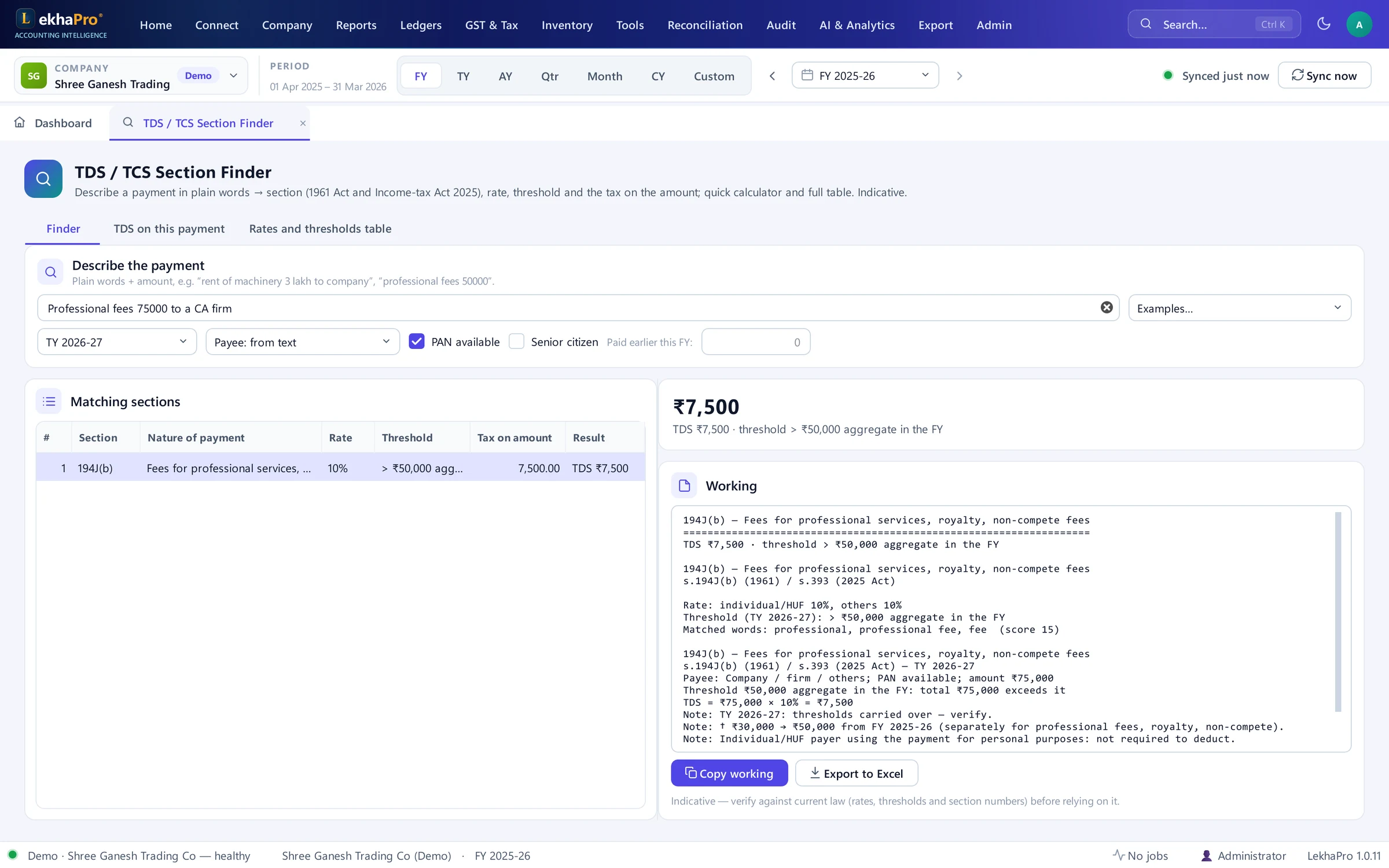
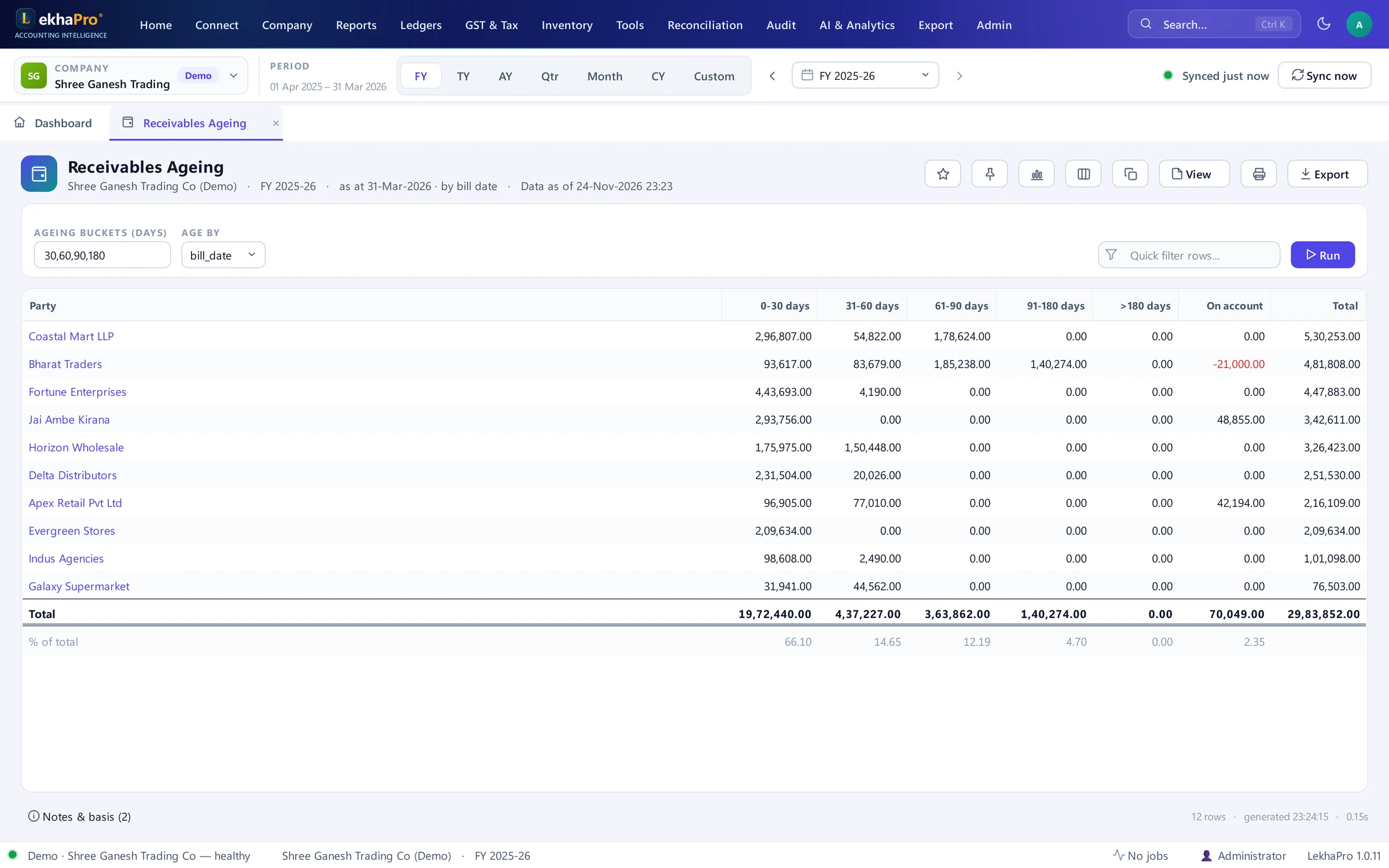
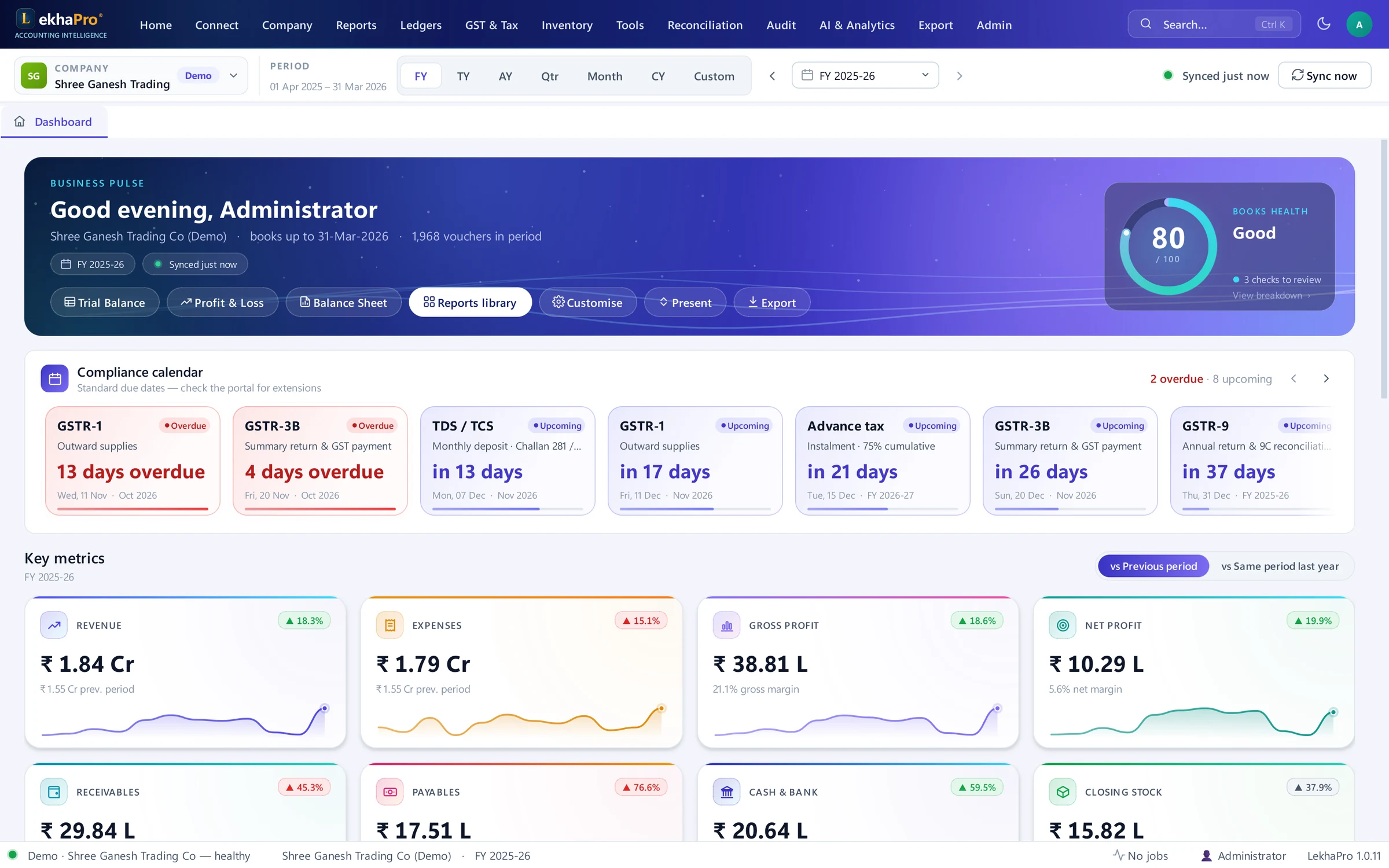
DashboardLekhaPro dashboard with business pulse, compliance calendar and key metrics
Questions
Schedule III, GSTR-2B, BUSY, MARG and audit
How do I prepare Schedule III statements from Tally?
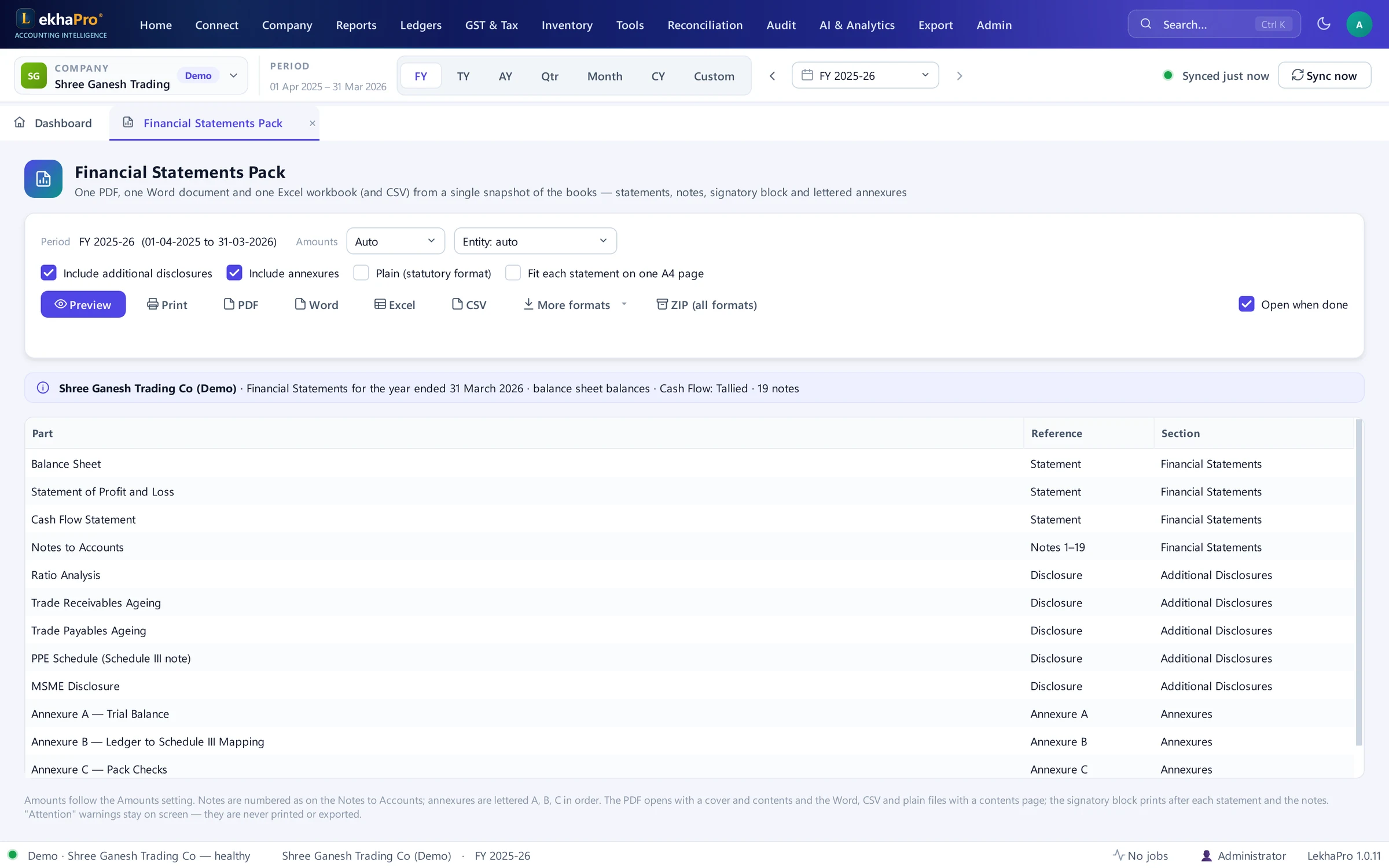
Connect the Tally company, choose the year and open the Schedule III Balance Sheet or Profit and Loss. LekhaPro maps ledgers to Schedule III lines, adds previous-year figures, notes, ageing and ratios, and lets you change the mapping and layout. Export to PDF, Word or Excel after your review.
Statements follow Division I of Schedule III. Year-end entries are kept beside the books.
How does GSTR-2B reconciliation work?
Import the GSTR-2B file downloaded from the GST portal as JSON, Excel or ZIP. LekhaPro compares it with purchases in the books by GSTIN, invoice number, date and value. It lists matched, different, missing and duplicate invoices, finds numbers typed differently, and shows the ITC at risk.
It also works for GSTR-2A and for filed GSTR-1 against sales, with an IMS worksheet and supplier follow-up letters.
Can it read BUSY, MARG and EasySol as well as Tally?
Yes. LekhaPro reads TallyPrime and Tally.ERP 9, BUSY, MARG ERP and EasySol directly, without exporting first. Any other software can come in through Excel, CSV, ODS, XML or JSON files, or a two-year trial balance. All of them use the same report library, so your working method stays the same.
Tally can be read live or from its data folder with Tally closed. Product names belong to their owners and are used only to say what LekhaPro can read.
Does LekhaPro file GST returns by itself?
No. LekhaPro makes files from the books and checks them before export: GSTR-1 JSON and Offline Tool Excel, GSTR-3B JSON, e-invoice and e-way bill bulk files and more. You review each file, upload it to the portal and file the return there with your own login.
Can it read a Tally company locked with TallyVault?
Only with the client's help. A TallyVault company is encrypted, and LekhaPro does not guess or break its password. The client can open it in Tally and let LekhaPro read it live, or remove the vault in Tally. Either way, the password is typed only into Tally itself.
Which audit checks does LekhaPro run?
LekhaPro runs an Exception Library of 128 rules on the books, with limits that you can tune for each company. Checks cover cash limits under sections 40A(3) and 269ST, duplicates, back-dated entries and Benford analysis. Sampling, a CARO 2020 builder and an anomaly ranking are included. Results need your review.
What are the CA tools?
There are 21 CA tools and 4 document tools in the desktop app. They include a PDF toolkit and editor, interest, late-fee and capital gains calculators, 26AS and AIS matching, registers for notices, UDIN and DSC, and certificates and letters. The file-based tools work only on the files that you choose.
See it on your own client's books
Ask for a personalised demo for your practice or finance team.